EPUB · English
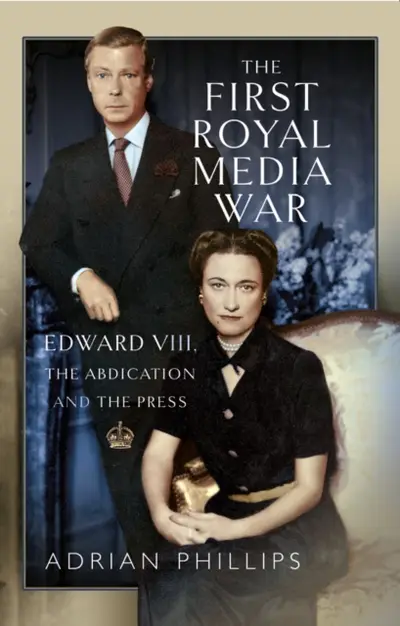
First Royal Media War
Edward VIII, The Abdication and the Press
Price and availability
$29.99
Available in: Andorra, Austria, Australia, Belgium, Bulgaria, Canada, Switzerland, Cyprus, Czechia, Germany, Denmark, Estonia, Spain, Finland, France, United Kingdom, Guernsey, Greece, Croatia, Hungary, Ireland, Isle of Man, Iceland, Italy, Jersey, Japan, Liechtenstein, Lithuania, Luxembourg, Latvia, Monaco, Malta, Netherlands, Norway, Poland, Portugal, Romania, Sweden, Slovenia, Slovakia, San Marino, United States, Vatican City, South Africa
Stores: US, UK, Canada, EU, Australia.
Sign in to buyThe price is re-checked by the server before payment.
For personal use under the eBook licence.
- Format
- EPUB
- DRM
- Not stated by the publisher
- Language
- English
- Publisher
- Pen & Sword Books
- Published
- 30 June 2023
- ISBN
- 9781399065436
- Subjects
- United Kingdom, Great Britain, Biography: royalty, European history, British & Irish history, Media studies, Media studies, European history
About this book
The abdication crisis of 1936 demolished the wall of silent deference that had protected the British royal family from press comment and intrusion since the days of Queen Victoria. King Edward VIII was a child of the burgeoning age of media and the first celebrity monarch, but the immense personal popularity created by his charm and good looks was not enough to save him when he came into conflict with a government that embodied the conservative ethos of the time. Nor did the support of powerful media barons. In the United States William Randolph Hearst, who inspired Citizen Kane, dreamed of giving Britain an American Queen and maneuvered with Wallis Simpson to place her on the throne. In Britain the Anglo- Canadian newspaper magnate Lord Beaverbrook hoped to use the confrontation between the King and the government to force the prime minister, his bitter enemy Stanley Baldwin, out of power. Edward was blocked from broadcasting his case directly to the public, which was the source of deep resentment to him. The government treated the couple's media initiatives as declarations of war and was prepared to respond savagely. The British press remained tactfully silent almost until the end of the crisis, but behind the scenes, a cold war was being fought. For the rest of his life, Edward fought to air his grievances against the ill-treatment to which he thought that he had been subjected. He believed that he had been forced to abdicate by a coalition of reactionaries grouped behind the Archbishop of Canterbury. Edward resented bitterly the ostracism to which he and Wallis were subjected by his brother and sister-in-law, King George VI and Queen Elizabeth, especially the refusal to grant his wife royal status. With sometimes farcical results, Edward tried to find authors who put over his side of the story. Beaverbrook supported Edward but tried to bend Edward's quest to fit his own agenda. The establishment did its utmost to restrain Edward and maintain a discreet silence over the crisis, but gradually members of the royal court abandoned reticence and fought back. The abdication challenged the British monarchy as an institution. A large part of the legacy is today's no-holds-barred media environment where the royal family's issues are fought in a ruthless glare of worldwide attention.
Bibliographic data © Gardners Books Ltd.