PDF · English
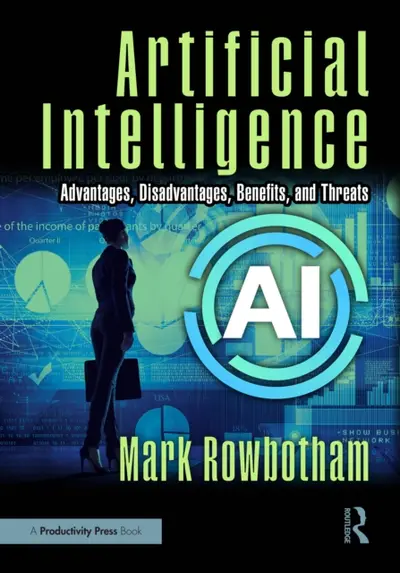
Artificial Intelligence
Advantages, Disadvantages, Benefits, and Threats
Price and availability
$63.99
Available in: Andorra, Austria, Australia, Belgium, Bulgaria, Canada, Switzerland, Cyprus, Czechia, Germany, Denmark, Estonia, Spain, Finland, France, United Kingdom, Guernsey, Greece, Croatia, Hungary, Ireland, Isle of Man, Iceland, Italy, Jersey, Japan, Liechtenstein, Lithuania, Luxembourg, Latvia, Monaco, Malta, Netherlands, Norway, Poland, Portugal, Romania, Sweden, Slovenia, Slovakia, San Marino, United States, Vatican City, South Africa
Stores: US, UK, Canada, EU, Australia.
Sign in to buyThe price is re-checked by the server before payment.
For personal use under the eBook licence.
- Format
- DRM
- Not stated by the publisher
- Language
- English
- Publisher
- Taylor & Francis
- Published
- 29 May 2026
- ISBN
- 9781040563281
- Subjects
- Business strategy, Management & management techniques, Knowledge management, Production & quality control management, Research & development management, Information technology industries, Production engineering, Artificial intelligence, Business strategy, Research and development management, Production and industrial engineering, Artificial intelligence (AI)
About this book
This book introduces the subject of artificial intelligence (AI), its structures, uses, application to the artificial neural network, technology applications, and the advantages and disadvantages of its use, including its potential weaknesses and drawbacks. AI, in its broadest sense, is intelligence exhibited by machines, particularly computer systems. It is a field of research in computer science that develops and studies methods and software that enable machines to perceive their environment and use learning and intelligence to take actions that maximize their chances of achieving defined goals. Such machines may be called AIs. AI technology is widely used throughout industry, government, and science.Some high-profile applications include advanced web search engines (e.g., Google Search); recommendation systems (used by platforms such as YouTube, Amazon, and Netflix); interacting via human speech (e.g., Google Assistant, Siri, and Alexa); autonomous vehicles (e.g., Waymo); generative and creative tools (e.g., ChatGPT, Apple Intelligence, and AI art); and superhuman play and analysis in strategy games (e.g., chess and Go). However, many AI applications are not perceived as AI. It would appear that much of specific AI has filtered into general applications, often without being called AI because once something becomes useful and common enough, it is no longer labelled as AI.The growing use of AI in the 21st century is influencing a societal and economic shift towards increased automation, data-driven decision-making, and the integration of AI systems into various economic and commercial sectors and areas of everyday life. Its impact is felt across job markets, healthcare, government, industry, education, propaganda, and disinformation and deception, whether deliberate or otherwise. This raises questions about the long-term effects, ethical implications, and risks of AI, prompting discussions about regulatory policies to ensure the safety and benefits of the technology.
Bibliographic data © Gardners Books Ltd.