PDF · English
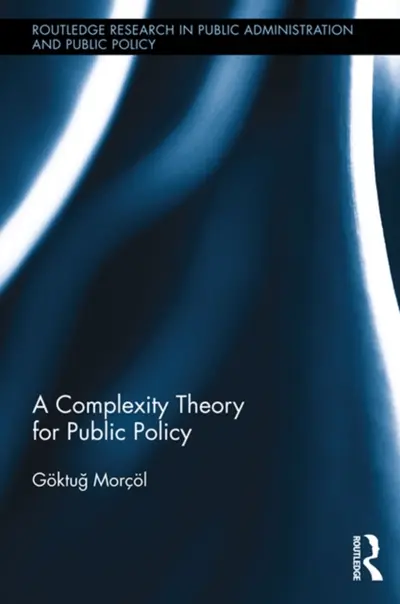
Complexity Theory for Public Policy
Price and availability
$83.99
Available in: Andorra, Austria, Australia, Belgium, Bulgaria, Canada, Switzerland, Cyprus, Czechia, Germany, Denmark, Estonia, Spain, Finland, France, United Kingdom, Guernsey, Greece, Croatia, Hungary, Ireland, Isle of Man, Iceland, Italy, Jersey, Japan, Liechtenstein, Lithuania, Luxembourg, Latvia, Monaco, Malta, Netherlands, Norway, Poland, Portugal, Romania, Sweden, Slovenia, Slovakia, San Marino, United States, Vatican City, South Africa
Stores: US, UK, Canada, EU, Australia.
Sign in to buyThe price is re-checked by the server before payment.
For personal use under the eBook licence.
- Format
- DRM
- Not stated by the publisher
- Language
- English
- Publisher
- Taylor & Francis
- Published
- 2 May 2013
- ISBN
- 9781136283475
- Subjects
- Politics & government, Public administration, Central government policies, Public ownership / nationalization, Research methods / methodology, Public administration / Public policy
About this book
Complexity theory has become popular in the natural and social sciences over the last few decades as a result of the advancements in our understanding of the complexities in natural and social phenomena. Concepts and methods of complexity theory have been applied by scholars of public affairs in North America and Europe, but a comprehensive framework for these applications is lacking. A Complexity Theory for Public Policy proposes a conceptual synthesis and sets a foundation for future developments and applications. In this book, Goktug Morcol convincingly makes the case that complexity theory can help us understand better the self-organizational, emergent, and co-evolutionary characteristics of complex policy systems. In doing so, he discuss the epistemological implications of complexity theory and the methods complexity researchers use, and those methods they could use. As the complexity studies spread more around the world in the coming decades, the contents of this book will become appealing to larger audiences, particularly to scholars and graduate students in public affairs. The unique combination of synthesis and explanation of concepts and methods found in this book will serve as reference frames for future works.
Bibliographic data © Gardners Books Ltd.