EPUB · English
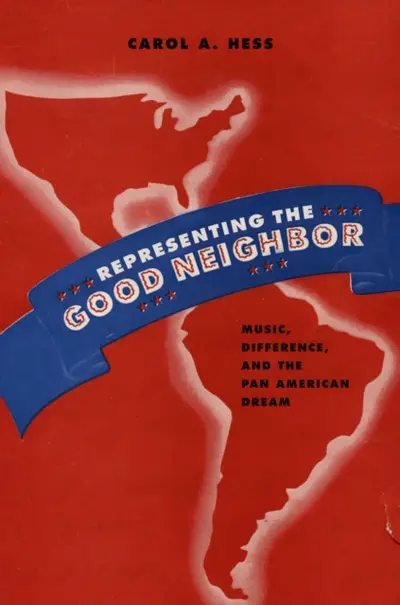
Representing the Good Neighbor
Music, Difference, and the Pan American Dream
Price and availability
$54.99
Available in: Andorra, Austria, Australia, Belgium, Bulgaria, Canada, Switzerland, Cyprus, Czechia, Germany, Denmark, Estonia, Spain, Finland, France, United Kingdom, Guernsey, Greece, Croatia, Hungary, Ireland, Isle of Man, Iceland, Italy, Jersey, Japan, Liechtenstein, Lithuania, Luxembourg, Latvia, Monaco, Malta, Netherlands, Norway, Poland, Portugal, Romania, Sweden, Slovenia, Slovakia, San Marino, United States, Vatican City, South Africa
Stores: US, UK, Canada, EU, Australia.
Sign in to buyThe price is re-checked by the server before payment.
For personal use under the eBook licence.
- Format
- EPUB
- DRM
- Not stated by the publisher
- Language
- English
- Publisher
- Oxford University Press
- Published
- 26 June 2013
- ISBN
- 9780199339891
- Subjects
- Latin America, 20th century & contemporary classical music, World music, History of the Americas, Hispanic & Latino studies, Latin America – Mexico, Central America, South America, AVLA, AVLW, JBSL, NHK
About this book
Winner of the 2015 Robert M. Stevenson Award from the American Musicological SocietyIn Representing the Good Neighbor: Music, Difference, and the Pan American Dream, Carol A. Hess investigates the reception of Latin American art music in the US during the twentieth century. Hers is the first study to probe Latin American art music in relation to Pan Americanism, or the idea that the American nations are bound by common aspirations. Under the Good Neighbor policy, crafted by the administration of President Franklin D. Roosevelt to cement hemispheric solidarity amid fears of European fascism, Latin American art music flourished and US critics applauded it as "e;universal."e; During the Cold War, however, this repertory assumed a very different status. While the United States supported Latin American military dictators to assuage fears that communism would overwhelm the hemisphere, musical works were increasingly objectified through essentializing adjectives such as "e;exotic,"e; distinctive,"e; or "e;national"e;--through the filter of difference. Hess explores this phenomenon by tracking the reception in the United States of the so-called Big Three: Carlos Chavez (Mexico), Heitor Villa-Lobos (Brazil), and Alberto Ginastera (Argentina). She also evaluates several important US composers and critics-Copland, Thomson, Rosenfeld, and others-in relation to Pan Americanism, and offers a new interpretation of a work about Latin America by US composer Fredric Rzewski, 36 Variations on "e;The People United Will Never Be Defeated!"e; Whether discussing works performed in modern music concerts of the 1920s, at the 1939 World's Fair, the inauguration of the New York State Theater in 1966, or for the US Bicentennial, Hess illuminates ways in which North-South relations continue to inform our understanding of Latin American art music today. As the first book to examine in detail the critical reception of Latin American music in the United States, Representing the Good Neighbor promises to be a landmark in the field of American music studies, and will be essential reading for students and scholars of music in the US and Latin America during the twentieth-century. It will also appeal to historians studying US-Latin America relations, as well as general readers interested in the history of American music.
Bibliographic data © Gardners Books Ltd.