PDF · English
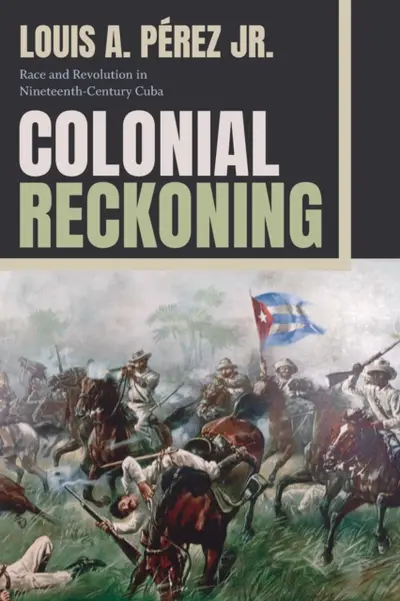
Colonial Reckoning
Race and Revolution in Nineteenth-Century Cuba
Price and availability
$37.99
Available in: Andorra, Austria, Australia, Belgium, Bulgaria, Canada, Switzerland, Cyprus, Czechia, Germany, Denmark, Estonia, Spain, Finland, France, United Kingdom, Guernsey, Greece, Croatia, Hungary, Ireland, Isle of Man, Iceland, Italy, Jersey, Japan, Liechtenstein, Lithuania, Luxembourg, Latvia, Monaco, Malta, Netherlands, Norway, Poland, Portugal, Romania, Sweden, Slovenia, Slovakia, San Marino, United States, Vatican City, South Africa
Stores: US, UK, Canada, EU, Australia.
Sign in to buyThe price is re-checked by the server before payment.
For personal use under the eBook licence.
- Format
- DRM
- Not stated by the publisher
- Language
- English
- Publisher
- Duke University Press
- Published
- 17 November 2023
- ISBN
- 9781478027584
- Subjects
- Cuba, History of the Americas, Ethnic studies, Ethnic minorities & multicultural studies, Cuba, JBSL, JBSL1, NHK
About this book
In Colonial Reckoning Louis A. Perez Jr. examines Cuba's wars for independence in the second half of the nineteenth century, focusing specifically on those Cubans who remained loyal to Spain. Drawing on newspaper articles, personal letters, military battle reports, government commissions, consular reports, literature, and other materials, Perez shows how everyday black, white, and creole Cubans defended the Spanish empire as paramilitary guerrillas alongside white elites. These loyalist Cubans helped the Spanish fight a separatist insurgency composed of a similarly diverse population of Cubans. Perez demonstrates that these wars were so deadly and drawn out precisely because Cubans fought on both sides, each holding myriad competing visions of sovereignty and contested meanings of nation. Complicating mythical and historiographical narratives that Cuban national liberation was a struggle waged between Cubans of color and white elites beholden to Spain, Perez shows that the fight consisted of a great number of factions with unique and evolving motivations. In so doing, he interrogates anew the multifaceted social dimensions and multiple political aspects of the complex drama of Cuban national formation.
Bibliographic data © Gardners Books Ltd.