EPUB · English
Orthodoxy
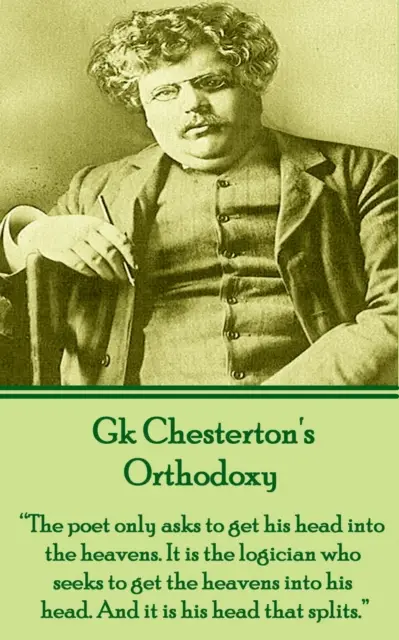
"The poet only asks to get his head into the heavens. It is the logician who seeks to get the heavens into his head. And it is his head that splits."
Price and availability
$2.99
Available in: Andorra, Austria, Australia, Belgium, Bulgaria, Canada, Switzerland, Cyprus, Czechia, Germany, Denmark, Estonia, Spain, Finland, France, United Kingdom, Guernsey, Greece, Croatia, Hungary, Ireland, Isle of Man, Iceland, Italy, Jersey, Japan, Liechtenstein, Lithuania, Luxembourg, Latvia, Monaco, Malta, Netherlands, Norway, Poland, Portugal, Romania, Sweden, Slovenia, Slovakia, San Marino, United States, Vatican City, South Africa
Stores: US, UK, Canada, EU, Australia.
Sign in to buyThe price is re-checked by the server before payment.
For personal use under the eBook licence.
- Format
- EPUB
- DRM
- Not stated by the publisher
- Language
- English
- Publisher
- Copyright Group
- Published
- 20 August 2013
- Pages
- 97
- ISBN
- 9781780008608
- Subjects
- Islamic & Arabic philosophy, QDHK
About this book
In Orthodoxy (1908), G.K. Chesterton speaks about his personal experience with orthodox Catholicism. While its companion volume entitled Heretics analyzes the weaknesses and flaws of modern materialistic philosophies, Orthodoxy is an argumentative, and yet humorous, defense of the Christian faith, its foundation and its utility. The work is divided into nine chapters with curious titles such as "e;The Suicide of Thought,"e; "e;The Ethics of Elfland,"e; and "e;The Romance of Orthodoxy."e; Chesterton insists that what he presents to the reader is far from being a serious theological treatise, but rather a "e;slovenly autobiography"e; that describes how he has found in Catholicism an answer to his deepest emotional and spiritual needs. He also argues that the pure belief in reason and science and the dismissal of imagination can only lead to an illusion of knowledge. There is always something to be imagined as human reason alone can never conceive of a global picture of existence. This is why Chesterton's analysis is also among the earliest invitations to question the absolutist trust in reason. What the human being needs is both reason and belief in concrete things, on the one hand, and larger horizons for the appreciation of the infinite and the eternal, on the other.
Bibliographic data © Gardners Books Ltd.