EPUB · English
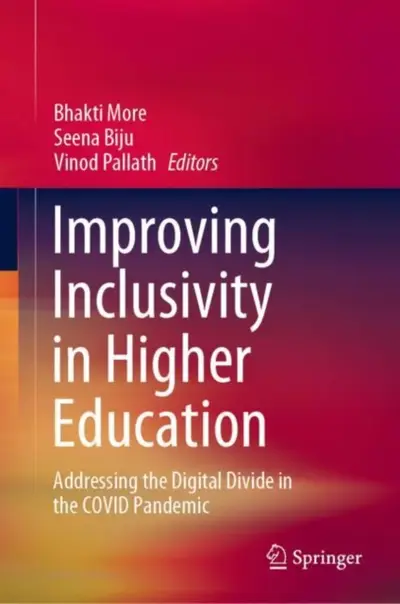
Improving Inclusivity in Higher Education
Addressing the Digital Divide in the COVID Pandemic
Price and availability
$175.99
Available in: Andorra, Austria, Australia, Belgium, Bulgaria, Canada, Switzerland, Cyprus, Czechia, Germany, Denmark, Estonia, Spain, Finland, France, United Kingdom, Guernsey, Greece, Croatia, Hungary, Ireland, Isle of Man, Iceland, Italy, Jersey, Japan, Liechtenstein, Lithuania, Luxembourg, Latvia, Monaco, Malta, Netherlands, Norway, Poland, Portugal, Romania, Sweden, Slovenia, Slovakia, San Marino, United States, Vatican City, South Africa
Stores: US, UK, Canada, EU, Australia.
Sign in to buyThe price is re-checked by the server before payment.
For personal use under the eBook licence.
- Format
- EPUB
- DRM
- Not stated by the publisher
- Language
- English
- Publisher
- Springer Nature Singapore
- Published
- 6 November 2023
- ISBN
- 9789819950768
- Subjects
- Asia, Cultural studies, Media studies, Higher & further education, tertiary education, Teaching of physically disabled students, Digital lifestyle, Asia, Cultural studies, Media studies: internet, digital media and society, Educational strategies and policy: inclusion, Higher education, tertiary education, Teaching of students with physical impairments or disabilities
About this book
This book addresses issues of access that COVID-19 brought forth in higher education, with a primary focus on Asian countries. In looking to address SDG4 to promote "e;inclusive and equitable quality education for all"e;, the volume explores the challenges relating to educational exclusion by considering how specially-abled students have been impacted by the digital divide in the context of the pandemic. It puts a spotlight on the approaches, experiences, and case analyses from various geographies in the region to study transitions in inclusivity. Universities and institutes of higher education have had to reconsider their digital offerings and services all the more since the onset of the pandemic, but have, in many instances, failed to fully account for how Internet access can be limited, unavailable, or unaffordable for many students. As a result, specially-abled learners - students without sufficient technological resources, such as those living in remote areas where there are little or no Internet facilities - have been, however unintentionally, neglected. While universities implemented their own practices, processes and policies to reach, and teach, disadvantaged learners, they had to further adapt these strategies, re-aligning them to meet the unprecedented circumstances, and concomitant needs, of specially-abled learners - and there is still much more to do. This book consolidates regional perspectives on how to work towards goals of inclusivity, and bridge the digital divide, looking into, and beyond, the conditions of the pandemic. Relevant to scholars and policymakers, this book is of interest to those focused on digitisation and the transition to the 'new normal' in higher education.
Bibliographic data © Gardners Books Ltd.