PDF · English
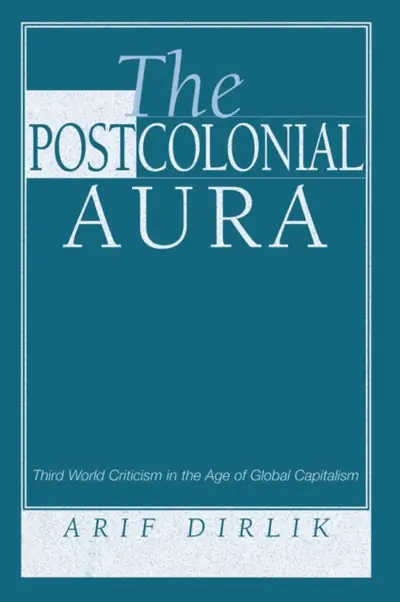
Postcolonial Aura
Third World Criticism In The Age Of Global Capitalism
Price and availability
$68.99
Available in: Andorra, Austria, Australia, Belgium, Bulgaria, Canada, Switzerland, Cyprus, Czechia, Germany, Denmark, Estonia, Spain, Finland, France, United Kingdom, Guernsey, Greece, Croatia, Hungary, Ireland, Isle of Man, Iceland, Italy, Jersey, Japan, Liechtenstein, Lithuania, Luxembourg, Latvia, Monaco, Malta, Netherlands, Norway, Poland, Portugal, Romania, Sweden, Slovenia, Slovakia, San Marino, United States, Vatican City, South Africa
Stores: US, UK, Canada, EU, Australia.
Sign in to buyThe price is re-checked by the server before payment.
For personal use under the eBook licence.
- Format
- DRM
- Not stated by the publisher
- Language
- English
- Publisher
- Taylor & Francis
- Published
- 20 February 2018
- ISBN
- 9780429964503
- Subjects
- Colonialism & imperialism, National liberation & independence, post-colonialism, Popular culture, Sociology, Anthropology, International relations, Political control & freedoms, World
About this book
The essays in this volume range from questions of cultural self-representation in China to more general problems of reconceptualizing global relationships in response to contemporary changes. Although the new era of global capitalism calls for the remapping of global relations, such remapping must be informed both by a grasp of contemporary structures of economic, political, and cultural power and by memories of earlier radical visions of society. Without these two conditions, Arif Dirlik argues, the current preoccupation with Eurocentrism, ethnic diversity, and multiculturalism distract from issues of power that dominate global relations and that find expression in murderous ethnic conflicts. Dirlik offers multi-historicalism, which presupposes a historically grounded conception of cultural difference, seeks in different histories alternative visions of human society, and stresses divergent historical trajectories against a future colonized presently by an ideology of capital. Arguing that the operations of capital have brought the question of the local to the fore, he points to indigenism as a source of paradigms of social relations, and relationships to nature, to challenge the voracious developmentalism that undermines local welfare globally.
Bibliographic data © Gardners Books Ltd.