EPUB · English
Reciprocal Frame Architecture
Price and availability
$218.99
Available in: Andorra, Austria, Australia, Belgium, Bulgaria, Canada, Switzerland, Cyprus, Czechia, Germany, Denmark, Estonia, Spain, Finland, France, United Kingdom, Guernsey, Greece, Croatia, Hungary, Ireland, Isle of Man, Iceland, Italy, Jersey, Japan, Liechtenstein, Lithuania, Luxembourg, Latvia, Monaco, Malta, Netherlands, Norway, Poland, Portugal, Romania, Sweden, Slovenia, Slovakia, San Marino, United States, Vatican City, South Africa
Stores: US, UK, Canada, EU, Australia.
Sign in to buyThe price is re-checked by the server before payment.
For personal use under the eBook licence.
- Format
- EPUB
- DRM
- Not stated by the publisher
- Language
- English
- Publisher
- Taylor & Francis
- Published
- 20 December 2007
- ISBN
- 9781136369650
- Subjects
- Architecture, Architectural structure & design, Mechanical engineering, Civil engineering, surveying & building, Building construction & materials, Architecture, Civil engineering, surveying and building
About this book
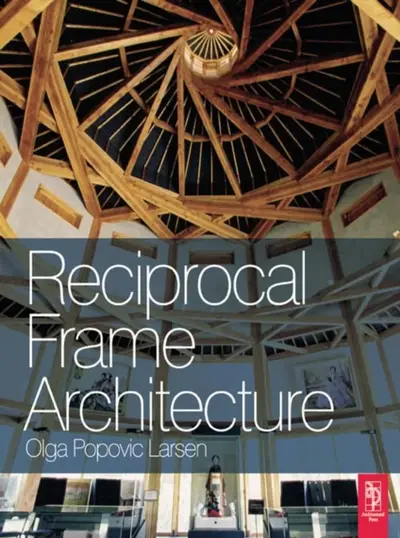
In structural terms reciprocal frame structures are 'three dimensional assemblies of mutually supporting beams'. But behind this definition lie some breathtakingly beautiful and complex structures at the heart of buildings both ancient and modern. This new book explores the principles of these apparently simple structures and demonstrates how they can be used in the context of a modern building. Starting with historic designs by de Honnecourt, Da Vinci and Serlio, the book presents the wealth of possible RF morphologies, and investigates the geometrical, structural and practical design issues of reciprocal frames. The case studies look at stunning examples of reciprocal frame architecture that range from low environmental impact buildings and self built examples in the UK and USA, to the fascinating and elegant structures of the Puppet Theatre in Seiwa, Tokyo's Spinning House, Sukiya Yu house, The Toyoson Stonemason museum and the Life Sciences Laboratory Torikabuto in Japan. The book is designed to inform and inspire architects and structural engineers alike, and brings to life a structural system whose principles have been used for thousands of years.
Bibliographic data © Gardners Books Ltd.