EPUB · English
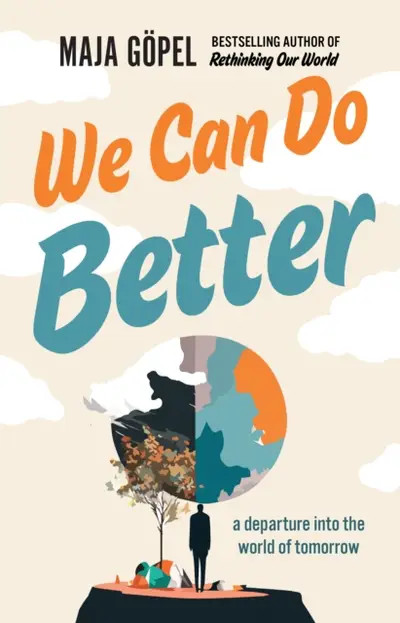
We Can Do Better
a departure into the world of tomorrow
Price and availability
$25.99
Available in: Andorra, Austria, Australia, Belgium, Bulgaria, Canada, Switzerland, Cyprus, Czechia, Germany, Denmark, Estonia, Spain, Finland, France, United Kingdom, Guernsey, Greece, Croatia, Hungary, Ireland, Isle of Man, Iceland, Italy, Jersey, Japan, Liechtenstein, Lithuania, Luxembourg, Latvia, Monaco, Malta, Netherlands, Norway, Poland, Portugal, Romania, Sweden, Slovenia, Slovakia, San Marino, United States, Vatican City, South Africa
Stores: US, UK, Canada, EU, Australia.
Sign in to buyThe price is re-checked by the server before payment.
For personal use under the eBook licence.
- Format
- EPUB
- DRM
- Not stated by the publisher
- Language
- English
- Publisher
- Scribe Publications Pty Ltd
- Published
- 3 April 2024
- Pages
- 352
- ISBN
- 9781761385575
- Subjects
- Development studies, History of ideas, Social issues & processes, Social forecasting, future studies, Social theory, Political structure & processes, Central government policies, Environmentalist thought & ideology, Development studies, History of ideas, Social forecasting, future studies, Social theory, Green politics / ecopolitics / environmentalism, Political structure and processes, Central / national / federal government policies, Political activism / Political engagement, Social impact of environmental issues
About this book
After her previous book, Rethinking Our World, eloquently untangled the complex world we live in, Maja Gopel delivers the encouragement and the tools we need to go into action and build the world we want to live in.Humanity is undergoing a massive process of transformation, and the way we live will change fundamentally, because things we have taken for granted about the environment, the economy, politics, society, and technology are crumbling. In We Can Do Better, Maja Gopel explains how we can understand such complex developments and use this knowledge to achieve a better world.There have always been great transformations in history, triggered by humans thus, we can also shape them. Our window to the future is open as never before. With this attitude, structural change is not an imposition, but an opportunity. It is time that we each of us individually, but also society as a whole allowed ourselves to think anew, to dream, and to ask two related, radical questions: Who do we want to be, and how do we want to live?
Bibliographic data © Gardners Books Ltd.