EPUB · English
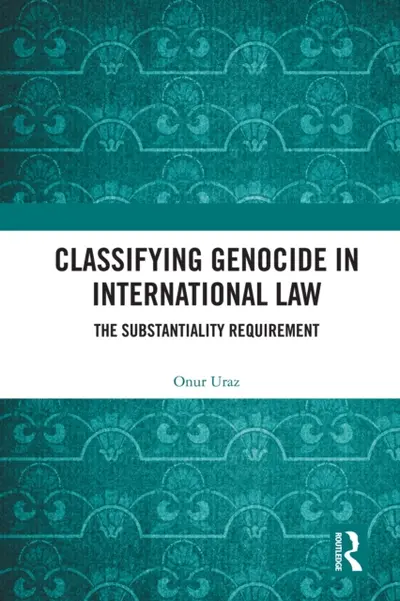
Classifying Genocide in International Law
The Substantiality Requirement
Price and availability
$59.99
Available in: Andorra, Austria, Australia, Belgium, Bulgaria, Canada, Switzerland, Cyprus, Czechia, Germany, Denmark, Estonia, Spain, Finland, France, United Kingdom, Guernsey, Greece, Croatia, Hungary, Ireland, Isle of Man, Iceland, Italy, Jersey, Japan, Liechtenstein, Lithuania, Luxembourg, Latvia, Monaco, Malta, Netherlands, Norway, Poland, Portugal, Romania, Sweden, Slovenia, Slovakia, San Marino, United States, Vatican City, South Africa
Stores: US, UK, Canada, EU, Australia.
Sign in to buyThe price is re-checked by the server before payment.
For personal use under the eBook licence.
- Format
- EPUB
- DRM
- Not stated by the publisher
- Language
- English
- Publisher
- Taylor & Francis
- Published
- 5 August 2022
- ISBN
- 9781000628562
- Subjects
- Genocide & ethnic cleansing, Society & culture: general, Crime & criminology, International relations, Armed conflict, War crimes, Jurisprudence & general issues, Criminology: legal aspects, International law, International criminal law, Courts & procedure, Criminal law & procedure, Criminal justice law, South Sudan, Public international law: human rights, Public international law: criminal law
About this book
This book offers an in-depth examination into genocide law by focusing on one of the lesser examined, yet practically significant, issues: the 'substantiality requirement'. This refers to the requirement in international law that intended destruction should be directed towards a 'substantial' part of a protected group in order for an atrocity to qualify as genocide. This comprehensive and detailed study draws connections between different judicial approaches to 'substantiality' and the varying theoretical presumptions about the constitutive concepts of the crime. This prima facia doctrinal problem is used as a springboard to scrutinise the broader theoretical problems underlying the legal conceptualisation of genocide. The book systematically explores how the individualistic and collectivistic conceptions of the crime have been able to co-exist in case law and how the different approaches to assessing substantiality have played a backdoor role between these two conceptions. The work demonstrates that these two philosophical standpoints are far from effectively representing the reality of the protected groups and fully explaining the harm inherent to group destruction. The book revisits the recent philosophical and sociological studies on the crime and, considering ideas from the emerging 'relational approaches to genocide', offers a third way to understand the existing legal representation of the crime and, consequently, the idea of 'substantiality'. It demonstrates the practical significance of its theoretical debates and applies its novel perspective through a case study on South Sudan. This book will be highly useful to students and scholars with an interest in genocide studies, international criminal law and legal theory. It will also be of interest to policymakers engaged with issues around genocide.
Bibliographic data © Gardners Books Ltd.