PDF · English
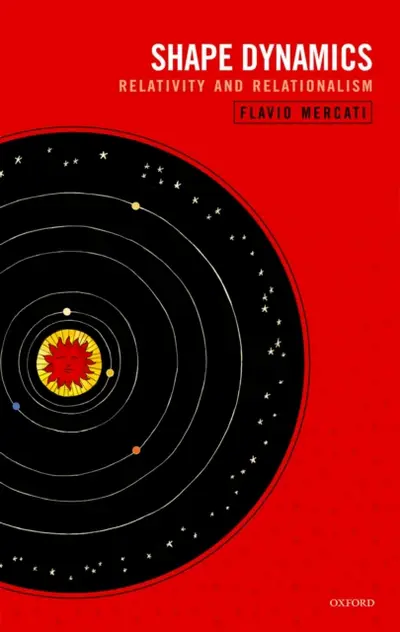
Shape Dynamics
Relativity and Relationalism
Price and availability
$52.99
Available in: Andorra, Austria, Australia, Belgium, Bulgaria, Canada, Switzerland, Cyprus, Czechia, Germany, Denmark, Estonia, Spain, Finland, France, United Kingdom, Guernsey, Greece, Croatia, Hungary, Ireland, Isle of Man, Iceland, Italy, Jersey, Japan, Liechtenstein, Lithuania, Luxembourg, Latvia, Monaco, Malta, Netherlands, Norway, Poland, Portugal, Romania, Sweden, Slovenia, Slovakia, San Marino, United States, Vatican City, South Africa
Stores: US, UK, Canada, EU, Australia.
Sign in to buyThe price is re-checked by the server before payment.
For personal use under the eBook licence.
- Format
- DRM
- Not stated by the publisher
- Language
- English
- Publisher
- Oxford University Press
- Published
- 2 March 2018
- ISBN
- 9780192506603
- Subjects
- Philosophy, History of science, Theoretical & mathematical astronomy, Relativity physics, Astrophysics, History of science, Theoretical and mathematical astronomy, Relativity physics, Astrophysics, Philosophy
About this book
This textbook on the nature of space and time explains the new theory of Space Dynamics, which describes the dynamics of gravity as the evolution of conformal 3-dimensional geometry. Shape Dynamics is equivalent to Einstein's General Relativity in those situations in which the latter has been tested experimentally, but the theory is based on different first principles. It differs from General Relativity in certain extreme conditions. Shape Dynamics allows us to describe situations in which the spacetime picture is no longer adequate, such as in the presence of singularities, when the idealization of infinitesimal rods measuring scales and infinitesimal clocks measuring proper time fails. This tutorial book contains both a quick introduction for readers curious about Shape Dynamics, and a detailed walk-through of the historical and conceptual motivations for the theory, its logical development from first principles and a description of its present status. It includes an explanation of the origin of the theory, starting from problems posed first by Newton more than 300 years ago. The book will interest scientists from a large community including all foundational fields of physics, from quantum gravity to cosmology and quantum foundations, as well as researchers interested in foundations. The tutorial is sufficiently self-contained for students with some basic background in Lagrangian/Hamiltonian mechanics and General Relativity.
Bibliographic data © Gardners Books Ltd.