EPUB · English
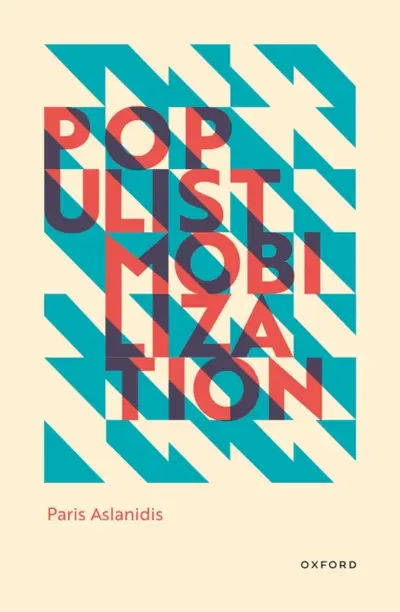
Populist Mobilization
Price and availability
$83.99
Available in: Andorra, Austria, Australia, Belgium, Bulgaria, Canada, Switzerland, Cyprus, Czechia, Germany, Denmark, Estonia, Spain, Finland, France, United Kingdom, Guernsey, Greece, Croatia, Hungary, Ireland, Isle of Man, Iceland, Italy, Jersey, Japan, Liechtenstein, Lithuania, Luxembourg, Latvia, Monaco, Malta, Netherlands, Norway, Poland, Portugal, Romania, Sweden, Slovenia, Slovakia, San Marino, United States, Vatican City, South Africa
Stores: US, UK, Canada, EU, Australia.
Sign in to buyThe price is re-checked by the server before payment.
For personal use under the eBook licence.
- Format
- EPUB
- DRM
- Not stated by the publisher
- Language
- English
- Publisher
- Oxford University Press
- Published
- 15 May 2025
- ISBN
- 9780198894605
- Subjects
- Social issues & processes, Political science & theory, Pressure groups & lobbying, Demonstrations & protest movements, Social and ethical issues, Political science and theory, Pressure groups, protest movements and non-violent action
About this book
While much of the political science literature on populism focuses on key political actors within the party system, a good deal less attention has been paid to forms of populist contention that feature ordinary citizens protesting against elite rule and championing the cause of 'the People' around the world. Populist Mobilization redresses this imbalance and presents a novel theoretical framework for the study of grassroots populist movements by integrating Laclauian discourse analysis with collective action frame theory. Aslanidis examines two widely influential movements that emerged from the protest cycle of the Great Recession: the Icelandic Pots and Pans Revolution and the Greek indignados. Drawing from semi-structured interviews with activists and an extensive analysis of the movements' paper trail and audiovisual material, he explores organizational aspects, processes of collective action framing, the construction of collective identities, and the influence of cultural elements. Additionally, the author embarks on a historical exploration of the intellectual roots of populism to dispel the pejorative connotations attached to the concept and advocates for a collaboration between sociologists and political scientists on a comprehensive research agenda for the populist phenomenon that transcends the institutional and non-institutional divide.
Bibliographic data © Gardners Books Ltd.