PDF · English
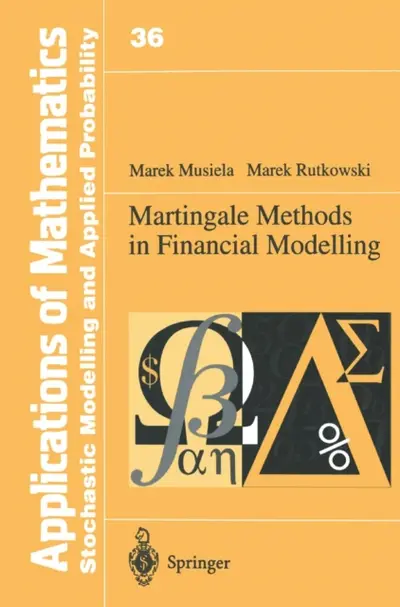
Martingale Methods in Financial Modelling
Price and availability
$97.99
Available in: Andorra, Austria, Australia, Belgium, Bulgaria, Canada, Switzerland, Cyprus, Czechia, Germany, Denmark, Estonia, Spain, Finland, France, United Kingdom, Guernsey, Greece, Croatia, Hungary, Ireland, Isle of Man, Iceland, Italy, Jersey, Japan, Liechtenstein, Lithuania, Luxembourg, Latvia, Monaco, Malta, Netherlands, Norway, Poland, Portugal, Romania, Sweden, Slovenia, Slovakia, San Marino, United States, Vatican City, South Africa
Stores: US, UK, Canada, EU, Australia.
Sign in to buyThe price is re-checked by the server before payment.
For personal use under the eBook licence.
- Format
- DRM
- Not stated by the publisher
- Language
- English
- Publisher
- Springer Berlin Heidelberg
- Published
- 29 June 2013
- ISBN
- 9783662221327
- Subjects
- Economic theory & philosophy, Economic statistics, Finance, Probability & statistics, Applied mathematics, Economics, Finance, Business and Management, Finance and the finance industry, Probability and statistics, Applied mathematics, Stochastics
About this book
The origin of this book can be traced to courses on financial mathemat- ics taught by us at the University of New South Wales in Sydney, Warsaw University of Technology (Politechnika Warszawska) and Institut National Polytechnique de Grenoble. Our initial aim was to write a short text around the material used in two one-semester graduate courses attended by students with diverse disciplinary backgrounds (mathematics, physics, computer sci- ence, engineering, economics and commerce). The anticipated diversity of potential readers explains the somewhat unusual way in which the book is written. It starts at a very elementary mathematical level and does not as- sume any prior knowledge of financial markets. Later, it develops into a text which requires some familiarity with concepts of stochastic calculus (the basic relevant notions and results are collected in the appendix). Over time, what was meant to be a short text acquired a life of its own and started to grow. The final version can be used as a textbook for three one-semester courses- one at undergraduate level, the other two as graduate courses. The first part of the book deals with the more classical concepts and results of arbitrage pricing theory, developed over the last thirty years and currently widely applied in financial markets. The second part, devoted to interest rate modelling is more subjective and thus less standard. A concise survey of short-term interest rate models is presented. However, the special emphasis is put on recently developed models built upon market interest rates.
Bibliographic data © Gardners Books Ltd.