PDF · English
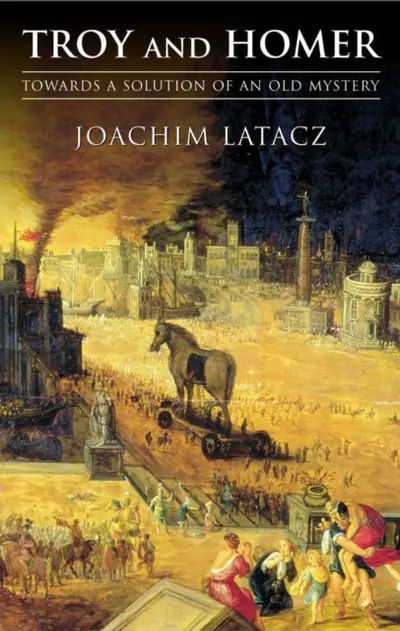
Troy and Homer
Towards a Solution of an Old Mystery
Price and availability
$114.99
Available in: Andorra, Austria, Australia, Belgium, Bulgaria, Canada, Switzerland, Cyprus, Czechia, Germany, Denmark, Estonia, Spain, Finland, France, United Kingdom, Guernsey, Greece, Croatia, Hungary, Ireland, Isle of Man, Iceland, Italy, Jersey, Japan, Liechtenstein, Lithuania, Luxembourg, Latvia, Monaco, Malta, Netherlands, Norway, Poland, Portugal, Romania, Sweden, Slovenia, Slovakia, San Marino, United States, Vatican City, South Africa
Stores: US, UK, Canada, EU, Australia.
Sign in to buyThe price is re-checked by the server before payment.
For personal use under the eBook licence.
- Format
- DRM
- Not stated by the publisher
- Language
- English
- Publisher
- Oxford University Press
- Published
- 28 October 2004
- ISBN
- 9780191555701
- Subjects
- Ancient World, BCE to c 500 CE, Literary studies: classical, early & medieval, European history, Middle Eastern history, Ancient history: to c 500 CE, Archaeology by period / region, Ancient World, Literary studies: ancient, classical and medieval, Ancient history, European history, Middle Eastern history, Archaeology by period / region
About this book
In this book Joachim Latacz turns the spotlight of modern research on the much-debated question of whether the wealthy city of Troy described by Homer in the Iliad was a poetic fiction or a memory of historical reality. Earlier excavations at the hill of Hisarlik, in Turkey, on the Dardanelles, brought no answer, but in 1988 a new archaeological enterprise, under the direction of Manfred Korfmann, led to a radical shift in understanding. Latacz, one of Korfmann's closest collaborators, traces the course of these excavations, and the renewed investigation of the imperial Hittite archives they have inspired. As he demonstrates, it is now clear that the background against which the plot of the Iliad is acted out is the historical reality of the thirteenth century BC. The Troy story as a whole must have arisen in this period, and we can detect traces of it in Homer's great poem.
Bibliographic data © Gardners Books Ltd.