PDF · English
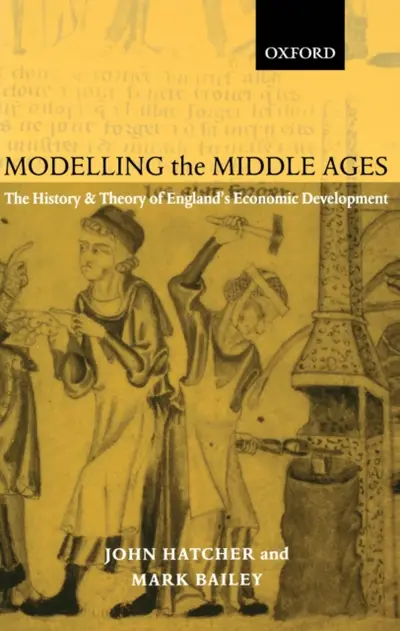
Modelling the Middle Ages
The History and Theory of England''s Economic Development
Price and availability
$59.99
Available in: Andorra, Austria, Australia, Belgium, Bulgaria, Canada, Switzerland, Cyprus, Czechia, Germany, Denmark, Estonia, Spain, Finland, France, United Kingdom, Guernsey, Greece, Croatia, Hungary, Ireland, Isle of Man, Iceland, Italy, Jersey, Japan, Liechtenstein, Lithuania, Luxembourg, Latvia, Monaco, Malta, Netherlands, Norway, Poland, Portugal, Romania, Sweden, Slovenia, Slovakia, San Marino, United States, Vatican City, South Africa
Stores: US, UK, Canada, EU, Australia.
Sign in to buyThe price is re-checked by the server before payment.
For personal use under the eBook licence.
- Format
- DRM
- Not stated by the publisher
- Language
- English
- Publisher
- OUP Oxford
- Published
- 3 May 2001
- ISBN
- 9780191554025
- Subjects
- England, c 1000 CE to c 1500, European history, Early history: c 500 to c 1450/1500, History of ideas, Economic history, England, History of ideas, Economic history, European history: medieval period, middle ages
About this book
Most of what has been written on the economy of the middle ages is deeply influenced by abstract concepts and theories. The most powerful and popular of these guiding beliefs are derived from intellectual foundations laid down in the eighteenth and nineteenth centuries by Adam Smith, Johan von Thunen, Thomas Malthus, David Ricardo, and Karl Marx. In the hands of twentieth-century historians and social scientists these venerable ideas have been moulded into three grand explanatory ideas which continue to dominate interpretations of economic development. These trumpet in turn the claims of 'commercialization', 'population and resources', or 'class power and property relations' as the prime movers of historical change. In this highly original book John Hatcher and Mark Bailey examine the structure and test the validity of these conflicting models from a variety of perspectives. In the course of their investigations they provide not only detailed reconstructions of the economic history of England in the middle ages and sustained critical commentaries on the work of leading historians, but also discussions of the philosophy and methods of history and the social sciences. The result is a short and readily intelligible introduction to medieval economic history, an up-to-date critique of established models, and a succinct treatise on historiographical method.
Bibliographic data © Gardners Books Ltd.