EPUB · English
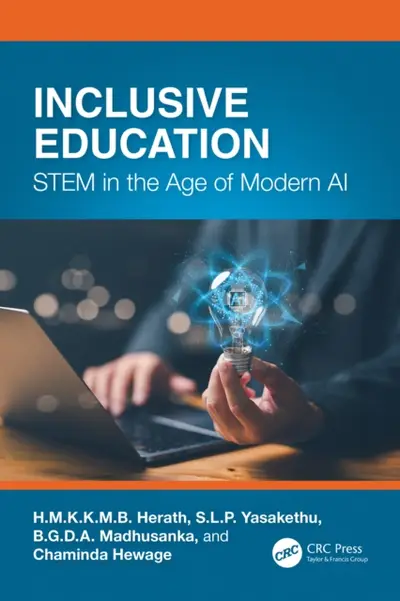
Inclusive Education
STEM in the Age of Modern AI
Price and availability
$75.99
Available in: Andorra, Austria, Australia, Belgium, Bulgaria, Canada, Switzerland, Cyprus, Czechia, Germany, Denmark, Estonia, Spain, Finland, France, United Kingdom, Guernsey, Greece, Croatia, Hungary, Ireland, Isle of Man, Iceland, Italy, Jersey, Japan, Liechtenstein, Lithuania, Luxembourg, Latvia, Monaco, Malta, Netherlands, Norway, Poland, Portugal, Romania, Sweden, Slovenia, Slovakia, San Marino, United States, Vatican City, South Africa
Stores: US, UK, Canada, EU, Australia.
Sign in to buyThe price is re-checked by the server before payment.
For personal use under the eBook licence.
- Format
- EPUB
- DRM
- Not stated by the publisher
- Language
- English
- Publisher
- CRC Press
- Published
- 27 March 2026
- ISBN
- 9781040669181
- Subjects
- Inclusive education / mainstreaming, Teaching skills & techniques, Algorithms & data structures, Computer architecture & logic design, Artificial intelligence, Teaching skills and techniques, Engineering: general, Electrical engineering, Automatic control engineering, Digital and Information technology: general topics, Algorithms and data structures, Computer architecture and logic design, Artificial intelligence (AI)
About this book
This book combines modern Artificial Intelligence (AI) and inclusive education learning systems methodologies. The book also provides an extensive discussion and methodologies related to STEM education to enhance future educational opportunities.Inclusive Education: STEM in the Age of Modern AI explores and provides an educational support system for students with special needs within the STEM education framework. The book is composed of five chapters. Chapter 1 introduces the evolution of inclusive education during the last two decades. This chapter also discusses the importance of having an equal education and current challenges in inclusive education. Chapter 2 discusses the AI methodologies that can provide solutions to inclusive education. Furthermore, it discusses how modern AI approaches, such as Generative AI (GenAI) and Large Language Models (LLMs), are integrated into inclusive education support systems. Chapter 3 introduces AI-supported systems for analyzing emotional and behavioral aspects in STEM education. Enhancing STEM learning for visual and hearing impairments has been discussed in Chapter 4. Finally, Chapter 5 introduces the Metaverse approach as a methodology for inclusive learning support in distance learning education.The book is written for a wide audience, such as STEM module learners, teachers, researchers, system developers, medical professionals, and industrial professionals, who interact in modern AI and education support system development.
Bibliographic data © Gardners Books Ltd.