EPUB · English
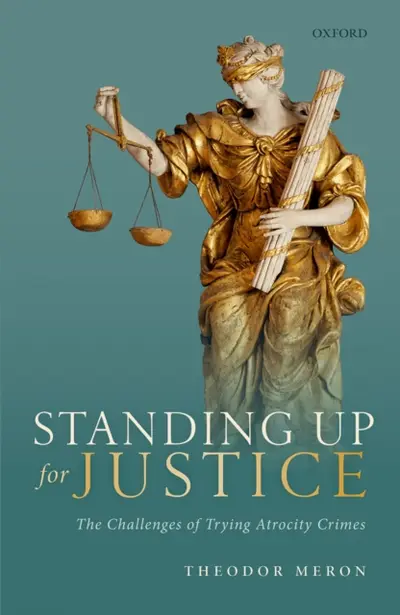
Standing Up for Justice
The Challenges of Trying Atrocity Crimes
Price and availability
$29.99
Available in: Andorra, Austria, Australia, Belgium, Bulgaria, Canada, Switzerland, Cyprus, Czechia, Germany, Denmark, Estonia, Spain, Finland, France, United Kingdom, Guernsey, Greece, Croatia, Hungary, Ireland, Isle of Man, Iceland, Italy, Jersey, Japan, Liechtenstein, Lithuania, Luxembourg, Latvia, Monaco, Malta, Netherlands, Norway, Poland, Portugal, Romania, Sweden, Slovenia, Slovakia, San Marino, United States, Vatican City, South Africa
Stores: US, UK, Canada, EU, Australia.
Sign in to buyThe price is re-checked by the server before payment.
For personal use under the eBook licence.
- Format
- EPUB
- DRM
- Not stated by the publisher
- Language
- English
- Publisher
- Oxford University Press
- Published
- 25 March 2021
- ISBN
- 9780192608628
- Subjects
- Politics & government, International criminal law, International courts & procedures, Politics and government, Public international law: criminal law, International law: courts and procedures
About this book
This is a book about international criminal justice written by one of its foremost practitioners and academic thinkers, Judge Theodor Meron. For two decades, Judge Meron has been at the heart of the international criminal justice system, serving as President of the International Criminal Tribunal for the former Yugoslavia (ICTY), President of the International Residual Mechanism for Criminal Tribunals, and a Judge of the Appeals Chambers of the ICTY and the International Criminal Tribunal for Rwanda. Drawing on this experience, and his life and career before serving as an international judge, Judge Meron reflects on some of the key questions facing the international criminal justice system. In the opening chapter, Judge Meron writes vividly about his childhood experiences in Poland during World War II, his education, career with the Israeli Foreign Ministry, and subsequent move into academia in the United States. The book continues with Meron's reflections on what it means to transform from a law professor into an international criminal judge, and shifts focus to the criminal courtroom, addressing topics such as the judicial function, the rule of law, and the principle of fairness in trying atrocity crimes: genocide, crimes against humanity, and war crimes. Judge Meron discusses judicial independence and impartiality in international criminal courts, shedding light on the mystery of judicial decision-making and deliberations. Notably, he addresses the controversial subjects of acquittals and the early release of prisoners. Although acquittals are often seen as a failure of international justice, Judge Meron argues that legal principle must come before any extraneous purpose, however desirable that purpose may be. Finally, the book looks ahead at the challenges facing the future of international justice and accountability, and discusses the all-important question: does international criminal justice work?
Bibliographic data © Gardners Books Ltd.