PDF · English
Antechamber
Toward a History of Waiting
Price and availability
$31.99
Available in: Andorra, Austria, Australia, Belgium, Bulgaria, Canada, Switzerland, Cyprus, Czechia, Germany, Denmark, Estonia, Spain, Finland, France, United Kingdom, Guernsey, Greece, Croatia, Hungary, Ireland, Isle of Man, Iceland, Italy, Jersey, Japan, Liechtenstein, Lithuania, Luxembourg, Latvia, Monaco, Malta, Netherlands, Norway, Poland, Portugal, Romania, Sweden, Slovenia, Slovakia, San Marino, United States, Vatican City, South Africa
Stores: US, UK, Canada, EU, Australia.
Sign in to buyThe price is re-checked by the server before payment.
For personal use under the eBook licence.
- Format
- DRM
- Not stated by the publisher
- Language
- English
- Publisher
- Stanford University Press
- Published
- 31 October 2023
- ISBN
- 9781503637030
- Subjects
- Western Continental Europe, The arts: general issues, History of art / art & design styles, European history, Social & cultural history, The arts: general topics, AGA, NHD, NHTB
About this book
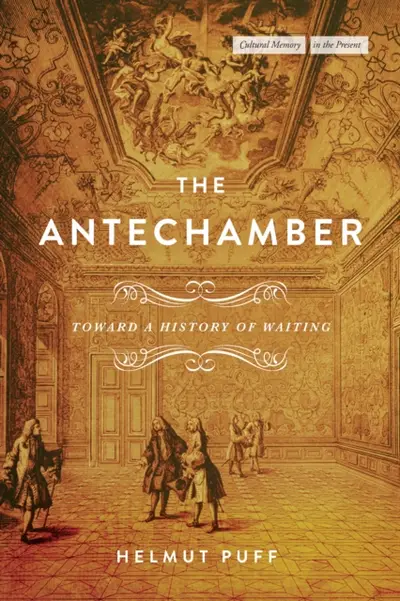
Helmut Puff invites readers to visit societies and spaces of the past through the lens of a particular temporal modality: waiting. From literature, memoirs, manuals, chronicles, visuals, and other documents, Puff presents a history of waiting anchored in antechambers-interior rooms designated and designed for people to linger.In early modern continental Western Europe, antechambers became standard in the residences of the elites. As a time-space infrastructure these rooms shaped encounters between unequals. By imposing spatial distance and temporal delays, antechambers constituted authority, rank, and power. Puff explores both the logic and the experience of waiting in such formative spaces, showing that time divides as much as it unites, and that far from what people have said about early moderns, they approached living in time with apprehensiveness. Unlike how contemporary society primarily views the temporal dimension, to early modern Europeans time was not an objective force external to the self but something that was tied to acting in time. Divided only by walls and doors, waiters sought out occasions to improve their lot. At other times, they disrupted the scripts accorded them. Situated at the intersection of history, literature, and the history of art and architecture, this wide-ranging study demonstrates that waiting has a history that has much to tell us about social and power relations in the past and present.
Bibliographic data © Gardners Books Ltd.