PDF · English
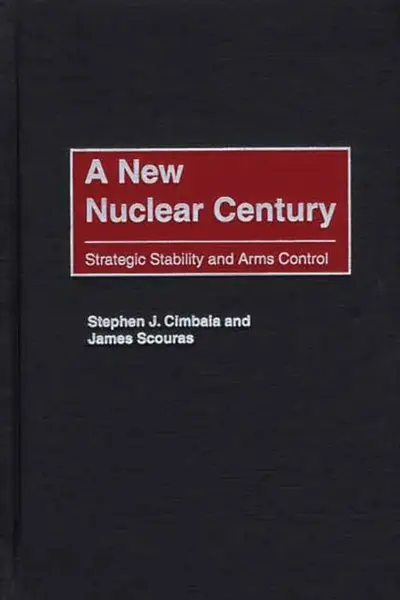
New Nuclear Century
Strategic Stability and Arms Control
Price and availability
$79.99
Available in: Andorra, Austria, Australia, Belgium, Bulgaria, Canada, Switzerland, Cyprus, Czechia, Germany, Denmark, Estonia, Spain, Finland, France, United Kingdom, Guernsey, Greece, Croatia, Hungary, Ireland, Isle of Man, Iceland, Italy, Jersey, Japan, Liechtenstein, Lithuania, Luxembourg, Latvia, Monaco, Malta, Netherlands, Norway, Poland, Portugal, Romania, Sweden, Slovenia, Slovakia, San Marino, United States, Vatican City, South Africa
Stores: US, UK, Canada, EU, Australia.
Sign in to buyThe price is re-checked by the server before payment.
For personal use under the eBook licence.
- Format
- DRM
- Not stated by the publisher
- Language
- English
- Publisher
- Bloomsbury Publishing (USA)
- Published
- 30 May 2002
- Pages
- 208
- ISBN
- 9780313012020
- Subjects
- Politics & government, Arms negotiation & control, Politics and government, Arms negotiation and control
About this book
Cimbala and Scouras examine the issues related to the control of nuclear weapons in the early 21st century. These issues are both technical and policy oriented; science and values are commingled. This means that arguments about nuclear strategy, arms control, and proliferation are apt to be contentious and confusing. The authors seek to provide readers with a fuller, more accurate understanding of the issues involved.They begin by analyzing the crazy mathematics of nuclear arms races and arms control that preoccupied analysts and policymakers during the Cold War. After examining stability modeling, they argue for a more comprehensive definition of strategic stability and they relate this more inclusive concept to the current relationship between the United States and Russia-one characterized by cooperation as well as competition. They then use the concept of friction to analyze how the gap between theory and practice might influence nuclear force operations and arms control. The problem of nuclear weapons spread or proliferation is then considered from the vantage point of both theory and policy. They conclude with an analysis of whether the United States might get by in the 21st century with fewer legs of its strategic nuclear triplet than weapons based on land, at sea, and airborne. A provocative analysis for arms control policymakers, strategists, and students, scholars, and other researchers involved with nuclear weapons issues.
Bibliographic data © Gardners Books Ltd.