EPUB · English
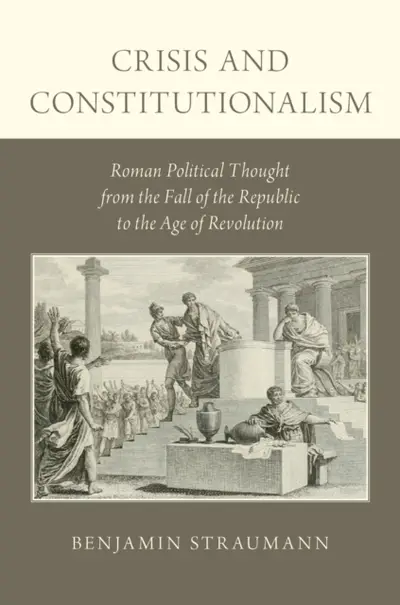
Crisis and Constitutionalism
Roman Political Thought from the Fall of the Republic to the Age of Revolution
Price and availability
$45.99
Available in: Andorra, Austria, Australia, Belgium, Bulgaria, Canada, Switzerland, Cyprus, Czechia, Germany, Denmark, Estonia, Spain, Finland, France, United Kingdom, Guernsey, Greece, Croatia, Hungary, Ireland, Isle of Man, Iceland, Italy, Jersey, Japan, Liechtenstein, Lithuania, Luxembourg, Latvia, Monaco, Malta, Netherlands, Norway, Poland, Portugal, Romania, Sweden, Slovenia, Slovakia, San Marino, United States, Vatican City, South Africa
Stores: US, UK, Canada, EU, Australia.
Sign in to buyThe price is re-checked by the server before payment.
For personal use under the eBook licence.
- Format
- EPUB
- DRM
- Not stated by the publisher
- Language
- English
- Publisher
- Oxford University Press
- Published
- 1 April 2016
- ISBN
- 9780190614003
- Subjects
- Ancient Rome, Ancient history: to c 500 CE, Classical history / classical civilisation, Politics & government, Political ideologies, Constitution: government & the state, Legal history, Constitutional & administrative law, 1QBAR, Politics and government, Political ideologies and movements, Constitution: government and the state, Legal history, Constitutional and administrative law: general, NHC
About this book
Crisis and Constitutionalism argues that the late Roman Republic saw, for the first time in the history of political thought, the development of a normative concept of constitution--the concept of a set of constitutional norms designed to guarantee and achieve certain interests of the individual. Benjamin Straumann first explores how a Roman concept of constitution emerged out of the crisis and fall of the Roman Republic. The increasing use of emergency measures and extraordinary powers in the late Republic provoked Cicero and some of his contemporaries to turn a hitherto implicit, inchoate constitutionalism into explicit constitutional argument and theory. The crisis of the Republic thus brought about a powerful constitutionalism and convinced Cicero to articulate the norms and rights that would provide its substance; this typically Roman constitutional theory is described in the second part of the study. Straumann then discusses the reception of Roman constitutional thought up to the late eighteenth century and the American Founding, which gave rise to a new, constitutional republicanism. This tradition was characterized by a keen interest in the Roman Republic's decline and fall, and an insistence on the limits of virtue. The crisis of the Republic was interpreted as a constitutional crisis, and the only remedy to escape the Republic's fate--military despotism--was thought to lie, not in republican virtue, but in Roman constitutionalism. By tracing Roman constitutional thought from antiquity to the modern era, this unique study makes a substantial contribution to our understanding of Roman political thought and its reception.
Bibliographic data © Gardners Books Ltd.