EPUB · English
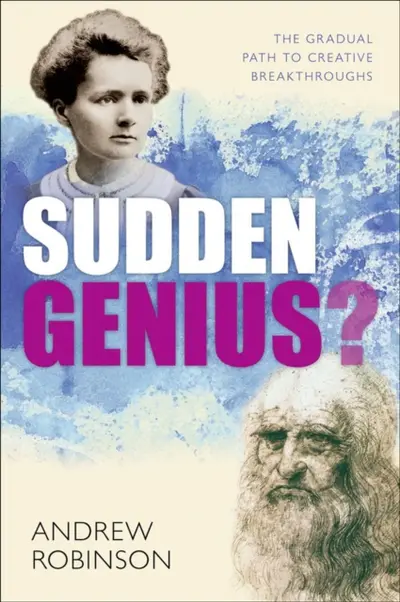
Sudden Genius?
The Gradual Path to Creative Breakthroughs
Price and availability
$9.99
Available in: Andorra, Austria, Australia, Belgium, Bulgaria, Canada, Switzerland, Cyprus, Czechia, Germany, Denmark, Estonia, Spain, Finland, France, United Kingdom, Guernsey, Greece, Croatia, Hungary, Ireland, Isle of Man, Iceland, Italy, Jersey, Japan, Liechtenstein, Lithuania, Luxembourg, Latvia, Monaco, Malta, Netherlands, Norway, Poland, Portugal, Romania, Sweden, Slovenia, Slovakia, San Marino, United States, Vatican City, South Africa
Stores: US, UK, Canada, EU, Australia.
Sign in to buyThe price is re-checked by the server before payment.
For personal use under the eBook licence.
- Format
- EPUB
- DRM
- Not stated by the publisher
- Language
- English
- Publisher
- OUP Oxford
- Published
- 16 September 2010
- ISBN
- 9780191624926
- Subjects
- Biography: general, Popular science, Popular psychology, Biography: general, Popular science, Popular psychology
About this book
The highly admired scientist Linus Pauling, a double Nobel laureate in chemistry and peace, was once asked by a student. 'Dr Pauling, how do you have so many good ideas?' Pauling thought for a moment and replied: 'Well, David, I have a lot of ideas and throw away the bad ones.'Where do ideas come from? Why do some people have many more of them than others? How do you distinguish the good ideas from the bad? Most intriguing of all, perhaps, why do the best ideas sometimes strike in a flash of 'sudden genius'? These questions are the subject of this book. Andrew Robinson explores the exceptional creativity in both scientists and artists by following the trail that led ten individuals from childhood to the achievement of a famous creative breakthrough as an adult, in archaeology, architecture, art, biology, chemistry, cinema, music, literature, photography, and physics. Broken into three parts, the book begins with the scientific study of creativity, covering talent, genius, intelligence, memory, dreams, the unconscious, savant syndrome, synaesthesia, and mental illness. The second part tells the stories of five breakthroughs by scientists and five by artists, ranging from Curie's discovery of radium and Einstein's theory of special relativity to Mozart's composing of The Marriage of Figaro and Virginia Woolf's writing of Mrs Dalloway. Robinson concludes by considering what highly creative people who achieve breakthroughs have in common; whether breakthroughs in science and art follow patterns; and whether they always involve imaginative leaps and even 'genius'.
Bibliographic data © Gardners Books Ltd.