PDF · English
Federico Barocci
Inspiration and Innovation in Early Modern Italy
Price and availability
$64.99
Available in: Andorra, Austria, Australia, Belgium, Bulgaria, Canada, Switzerland, Cyprus, Czechia, Germany, Denmark, Estonia, Spain, Finland, France, United Kingdom, Guernsey, Greece, Croatia, Hungary, Ireland, Isle of Man, Iceland, Italy, Jersey, Japan, Liechtenstein, Lithuania, Luxembourg, Latvia, Monaco, Malta, Netherlands, Norway, Poland, Portugal, Romania, Sweden, Slovenia, Slovakia, San Marino, United States, Vatican City, South Africa
Stores: US, UK, Canada, EU, Australia.
Sign in to buyThe price is re-checked by the server before payment.
For personal use under the eBook licence.
- Format
- DRM
- Not stated by the publisher
- Language
- English
- Publisher
- Taylor & Francis
- Published
- 22 September 2017
- ISBN
- 9781351617277
- Subjects
- Europe, Italy, History of art / art & design styles, History of art & design styles: c 1400 to c 1600, Renaissance art, Art & design styles: Baroque, Painting & paintings, Individual artists, art monographs, Religious subjects depicted in art, European history, Early modern history: c 1450/1500 to c 1700, Painting & art manuals, Marche, Paintings and painting, Individual artists, art monographs, Exhibition catalogues and specific collections
About this book
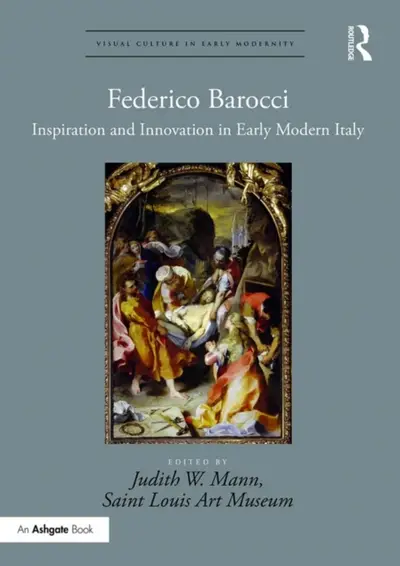
Reviewers of a recent exhibition termed Federico Barocci (ca. 1533-1612), 'the greatest artist you've never heard of'. One of the first original iconographers of the Counter Reformation, Barocci was a remarkably inventive religious painter and draftsman, and the first Italian artist to incorporate extensive color into his drawings. The purpose of this volume is to offer new insights into Barocci's work and to accord this artist, the dates of whose career fall between the traditional Renaissance and Baroque periods, the critical attention he deserves. Employing a range of methodologies, the essays include new ideas on Barocci's masterpiece, the Entombment of Christ; fresh thinking about his use of color in his drawings and innovative design methods; insights into his approach to the nude; revelations on a key early patron; a consideration of the reasons behind some of his most original iconography; an analysis of his unusual approach to the marketing of his pictures; an exploration of some little-known aspects of his early production, such as his reliance on Italian majolica and contemporary sculpture in developing his compositions; and an examination of a key Barocci document, the post mortem inventory of his studio. A translated transcription of the inventory is included as an appendix.
Bibliographic data © Gardners Books Ltd.