EPUB · English
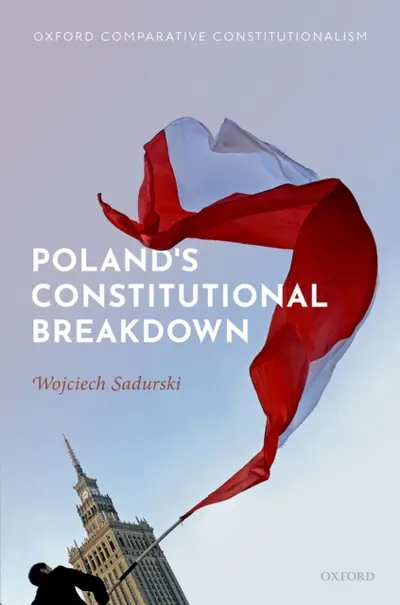
Poland's Constitutional Breakdown
Price and availability
$40.99
Available in: Andorra, Austria, Australia, Belgium, Bulgaria, Canada, Switzerland, Cyprus, Czechia, Germany, Denmark, Estonia, Spain, Finland, France, United Kingdom, Guernsey, Greece, Croatia, Hungary, Ireland, Isle of Man, Iceland, Italy, Jersey, Japan, Liechtenstein, Lithuania, Luxembourg, Latvia, Monaco, Malta, Netherlands, Norway, Poland, Portugal, Romania, Sweden, Slovenia, Slovakia, San Marino, United States, Vatican City, South Africa
Stores: US, UK, Canada, EU, Australia.
Sign in to buyThe price is re-checked by the server before payment.
For personal use under the eBook licence.
- Format
- EPUB
- DRM
- Not stated by the publisher
- Language
- English
- Publisher
- Oxford University Press
- Published
- 16 May 2019
- ISBN
- 9780192576972
- Subjects
- Poland, c 2010 to c 2020, Political structure & processes, Constitution: government & the state, Political structures: democracy, Civil rights & citizenship, Political oppression & persecution, Political activism, Political corruption, Constitutional & administrative law, Poland, Political structure and processes, Political oppression and persecution, Corruption in politics, government and society, Constitutional and administrative law: general
About this book
Since 2015, Poland's populist Law and Justice Party (PiS) has been dismantling the major checks and balances of the Polish state and subordinating the courts, the civil service, and the media to the will of the executive. Political rights have been radically restricted, and the Party has captured the entire state apparatus. The speed and depth of these antidemocratic movements took many observers by surprise: until now, Poland was widely regarded as an example of a successful transitional democracy. Poland's anti-constitutional breakdown poses three questions that this book sets out to answer: What, exactly, has happened since 2015? Why did it happen? And what are the prospects for a return to liberal democracy? These answers are formulated against a backdrop of current worldwide trends towards populism, authoritarianism, and what is sometimes called 'illiberal democracy'. As this book argues, the Polish variant of 'illiberal democracy' is an oxymoron. By undermining the separation of powers, the PiS concentrates all power in its own hands, rendering any democratic accountability illusory. There is, however, no inevitability in these anti-democratic trends: this book considers a number of possible remedies and sources of hope, including intervention by the European Union.
Bibliographic data © Gardners Books Ltd.