PDF · English
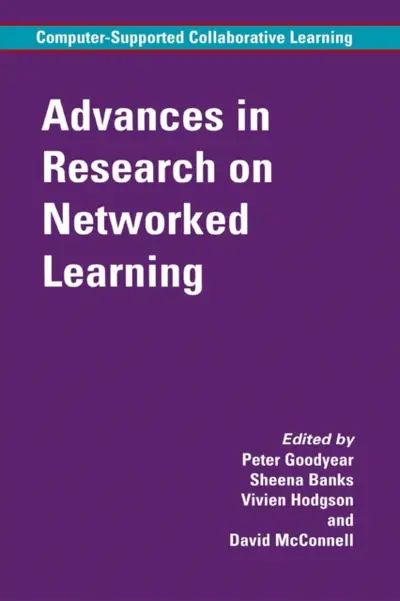
Advances in Research on Networked Learning
Price and availability
$120.99
Available in: Andorra, Austria, Australia, Belgium, Bulgaria, Canada, Switzerland, Cyprus, Czechia, Germany, Denmark, Estonia, Spain, Finland, France, United Kingdom, Guernsey, Greece, Croatia, Hungary, Ireland, Isle of Man, Iceland, Italy, Jersey, Japan, Liechtenstein, Lithuania, Luxembourg, Latvia, Monaco, Malta, Netherlands, Norway, Poland, Portugal, Romania, Sweden, Slovenia, Slovakia, San Marino, United States, Vatican City, South Africa
Stores: US, UK, Canada, EU, Australia.
Sign in to buyThe price is re-checked by the server before payment.
For personal use under the eBook licence.
- Format
- DRM
- Not stated by the publisher
- Language
- English
- Publisher
- Springer Netherlands
- Published
- 11 April 2006
- ISBN
- 9781402079092
- Subjects
- Education, Educational psychology, Open learning, home learning, distance education, Educational equipment & technology, computer-aided learning (CAL), Human-computer interaction, User interface design & usability, Education / Educational sciences / Pedagogy, Educational psychology, Educational equipment and technology, computer-aided learning (CAL), Human–computer interaction
About this book
Networked learning is learning in which information and communications technology (ICT) is used to promote connections: between one learner and other learners; between learners and tutors; between a learning community and its learning resources. Networked learning is an area which has great practical and theoretical importance. It is a rapidly growing area of educational practice, particularly in higher education and the corporate sector. This volume brings together some of the best research in the field, and uses it to signpost some directions for future work. The papers in this collection represent a major contribution to our collective sense of recent progress in research on networked learning. In addition, they serve to highlight some of the largest or most important gaps in our understanding of students perspectives on networked learning, patterns of interaction and online discourse, and the role of contextual factors. The range of topics and methods addressed in these papers attests to the vitality of this important field of work. More significant yet is the complex understanding of the field that they combine to create. In combination, they help explain some of the key relationships between teachers and learners intentions and experiences, the affordances of text-based communications technologies and processes of informed and intelligent educational change.
Bibliographic data © Gardners Books Ltd.