PDF · English
Mobilizing the Marginalized
Ethnic Parties without Ethnic Movements
Price and availability
$21.99
Available in: Andorra, Austria, Australia, Belgium, Bulgaria, Canada, Switzerland, Cyprus, Czechia, Germany, Denmark, Estonia, Spain, Finland, France, United Kingdom, Guernsey, Greece, Croatia, Hungary, Ireland, Isle of Man, Iceland, Italy, Jersey, Japan, Liechtenstein, Lithuania, Luxembourg, Latvia, Monaco, Malta, Netherlands, Norway, Poland, Portugal, Romania, Sweden, Slovenia, Slovakia, San Marino, United States, Vatican City, South Africa
Stores: US, UK, Canada, EU, Australia.
Sign in to buyThe price is re-checked by the server before payment.
For personal use under the eBook licence.
- Format
- DRM
- Not stated by the publisher
- Language
- English
- Publisher
- Oxford University Press
- Published
- 26 June 2019
- ISBN
- 9780190916442
- Subjects
- Comparative politics, Elections & referenda, International business, Comparative politics, Elections and referenda / suffrage, International business
About this book
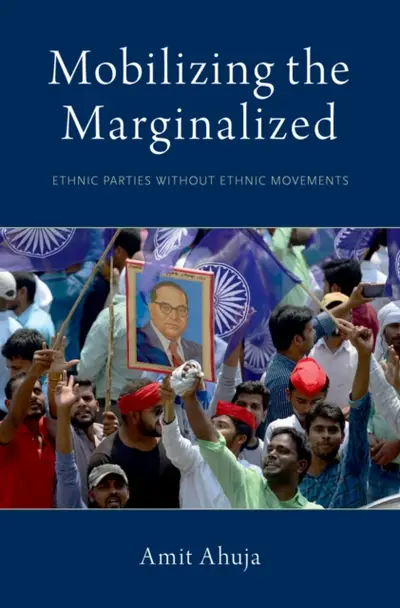
India's over 200 million Dalits, once called "e;untouchables,"e; have been mobilized by social movements and political parties, but the outcomes of this mobilization are puzzling. Dalits' ethnic parties have performed poorly in elections in states where movements demanding social equality have been strong while they have succeeded in states where such movements have been entirely absent or weak. In Mobilizing the Marginalized, Amit Ahuja demonstrates that the collective action of marginalized groups--those that are historically stigmatized and disproportionately poor - is distinct. Drawing on extensive original research conducted across four of India's largest states, he shows, for the marginalized, social mobilization undermines the bloc voting their ethnic parties' rely on for electoral triumph and increases multi-ethnic political parties' competition for marginalized votes. He presents evidence showing that a marginalized group gains more from participating in a social movement and dividing support among parties than from voting as a bloc for an ethnic party.
Bibliographic data © Gardners Books Ltd.