EPUB · English
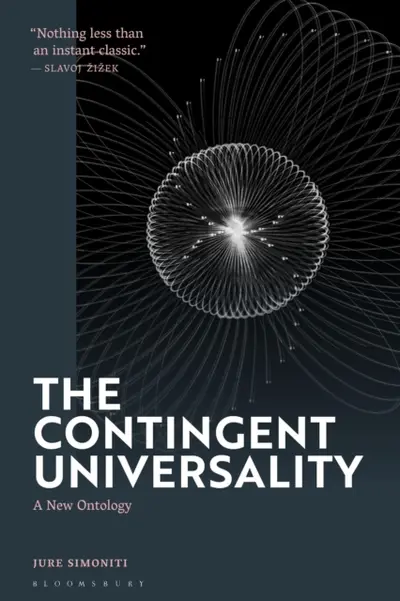
Contingent Universality
A New Ontology
Price and availability
$103.99
Available in: Andorra, Austria, Australia, Belgium, Bulgaria, Canada, Switzerland, Cyprus, Czechia, Germany, Denmark, Estonia, Spain, Finland, France, United Kingdom, Guernsey, Greece, Croatia, Hungary, Ireland, Isle of Man, Iceland, Italy, Jersey, Japan, Liechtenstein, Lithuania, Luxembourg, Latvia, Monaco, Malta, Netherlands, Norway, Poland, Portugal, Romania, Sweden, Slovenia, Slovakia, San Marino, United States, Vatican City, South Africa
Stores: US, UK, Canada, EU, Australia.
Sign in to buyThe price is re-checked by the server before payment.
For personal use under the eBook licence.
- Format
- EPUB
- DRM
- Not stated by the publisher
- Language
- English
- Publisher
- Bloomsbury Publishing
- Published
- 1 October 2026
- Pages
- 240
- ISBN
- 9781350514744
- Subjects
- Western philosophy, from c 1900 -, Philosophy: metaphysics & ontology, Social & political philosophy, QDHR, QDTJ, QDTS
About this book
There may be such a thing as the most unbearable of all philosophical thoughts: the realization of the absolute contingency of the emergence of universals and the correlative insight that the only true universality is the contingency of everything.The entire history of philosophy can be seen as an endeavor to keep universality and contingency apart by setting up frameworks that promise to shield the sovereignty of truth from the fortuity of the current state of things. The Contingent Universality proposes a radical inversion. Under the sway of Platonism, we tend to associate contingency with the imperfect reign of particular things before our eyes, and universality with a more stable but remote order pulling the strings from afar. But what if it is the other way around? Could it be that we live in a world where no cosmic Law has ruled from the beginning of time, and that, for want of any Total Law, the only place left for universality to unfold is right here?Tracing a sweeping intellectual arc from Plato through Kant and Hegel to the post-metaphysical thought of Kierkegaard, Nietzsche, Heidegger, and Wittgenstein, and building its case on the scientific revolutions from Copernicus onward, the book carries through an operation implicit in the philosophy of Slavoj i ek. In doing so, it provides new answers to questions concerning the nature of contingency, necessity, the predictability of the future, the validity of the laws of nature, and the relation between singularity and universality, chaos and order, reality and truth.
Bibliographic data © Gardners Books Ltd.