PDF · English
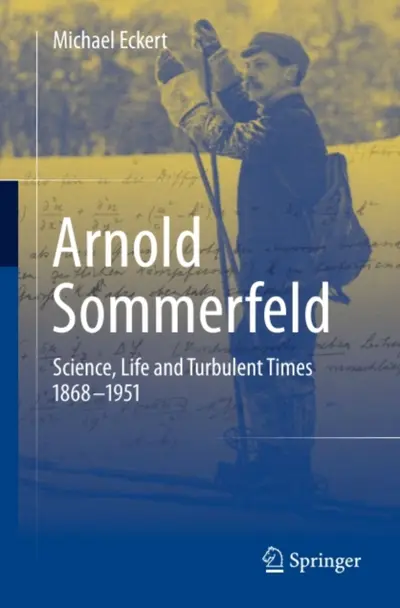
Arnold Sommerfeld
Science, Life and Turbulent Times 1868-1951
Price and availability
$106.99
Available in: Andorra, Austria, Australia, Belgium, Bulgaria, Canada, Switzerland, Cyprus, Czechia, Germany, Denmark, Estonia, Spain, Finland, France, United Kingdom, Guernsey, Greece, Croatia, Hungary, Ireland, Isle of Man, Iceland, Italy, Jersey, Japan, Liechtenstein, Lithuania, Luxembourg, Latvia, Monaco, Malta, Netherlands, Norway, Poland, Portugal, Romania, Sweden, Slovenia, Slovakia, San Marino, United States, Vatican City, South Africa
Stores: US, UK, Canada, EU, Australia.
Sign in to buyThe price is re-checked by the server before payment.
For personal use under the eBook licence.
- Format
- DRM
- Not stated by the publisher
- Language
- English
- Publisher
- Springer New York
- Published
- 24 June 2013
- ISBN
- 9781461474616
- Subjects
- Biography: science, technology & medicine, Philosophy of science, Physics, Thermodynamics & heat, Atomic & molecular physics, Quantum physics (quantum mechanics & quantum field theory), Mathematical physics, Geophysics, Philosophy of science, Physics, Classical mechanics, Gravity, Quantum physics (quantum mechanics and quantum field theory), Mathematical / Computational / Theoretical physics
About this book
The subject of the book is a biography of the theoretical physicist Arnold Sommerfeld (1868-1951). Although Sommerfeld is famous as a quantum theorist for the elaboration of the semi-classical atomic theory (Bohr-Sommerfeld model, Sommerfeld's fine-structure constant), his role in the history of modern physics is not confined to atoms and quanta. Sommerfeld left his mark in the history of mathematics, fluid mechanics, a number of physical subdisciplines and, in particular, as founder of a most productive "e;school"e; (Peter Debye, Wolfgang Pauli, Werner Heisenberg, Linus Pauling and Hans Bethe were his pupils, to name only the Nobel laureates among them). This biography is to a large extent based on primary source material (correspondence, diaries, unpublished manuscripts). It should be of particular interest to students who are keen to know more about the historical roots of modern science. Sommerfeld lived through turbulent times of German history (Wilhelmian Empire, Weimar Republic, Nazi period). His life, therefore, illustrates how science and scientists perform in changing social environments. From this perspective, the biography should also attract readers with a general interest in the history of science and technology.
Bibliographic data © Gardners Books Ltd.