PDF · English
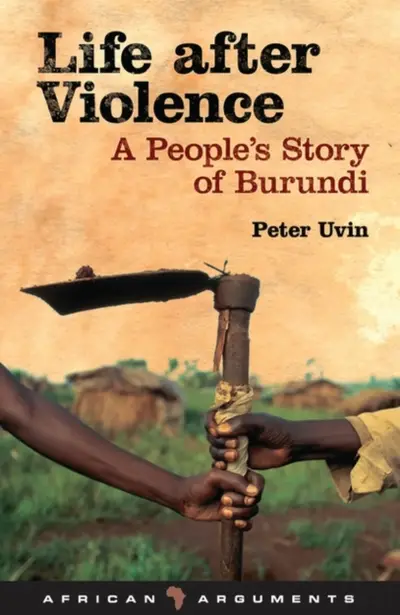
Life after Violence
A People''s Story of Burundi
Price and availability
$24.99
Available in: Andorra, Austria, Australia, Belgium, Bulgaria, Canada, Switzerland, Cyprus, Czechia, Germany, Denmark, Estonia, Spain, Finland, France, United Kingdom, Guernsey, Greece, Croatia, Hungary, Ireland, Isle of Man, Iceland, Italy, Jersey, Japan, Liechtenstein, Lithuania, Luxembourg, Latvia, Monaco, Malta, Netherlands, Norway, Poland, Portugal, Romania, Sweden, Slovenia, Slovakia, San Marino, United States, Vatican City, South Africa
Stores: US, UK, Canada, EU, Australia.
Sign in to buyThe price is re-checked by the server before payment.
For personal use under the eBook licence.
- Format
- DRM
- Not stated by the publisher
- Language
- English
- Publisher
- Bloomsbury Publishing
- Published
- 15 June 2009
- Pages
- 224
- ISBN
- 9781848131811
- Subjects
- East Africa, Peace studies & conflict resolution, African history, Postwar 20th century history, from c 1945 to c 2000, Social & cultural history, Genocide & ethnic cleansing, GTU, NH, NHH, NHTB, NHTZ
About this book
Burundi has recently emerged from twelve years of devastating civil war. Its economy has been destroyed and hundreds and thousands of people have been killed. In this book, the voices of ordinary Burundians are heard for the first time.Farmers, artisans, traders, mothers, soldiers and students talk about the past and the future, war and peace, their hopes for a better life and their relationships with each other and the state. Young men, in particular, often seen as the cause of violence and war, talk about the difficulties of living up to standards of masculinity in an impoverished and war-torn society.Weaving a rich tapestry, Peter Uvin pitches the ideas and aspirations of people on the ground against the theory and assumptions often made by the international development and peace-building agencies and organisations. In doing this, he illuminates both shared goals and misunderstandings. This groundbreaking book on conflict and society in Africa will have profound repercussions for development across the world.
Bibliographic data © Gardners Books Ltd.