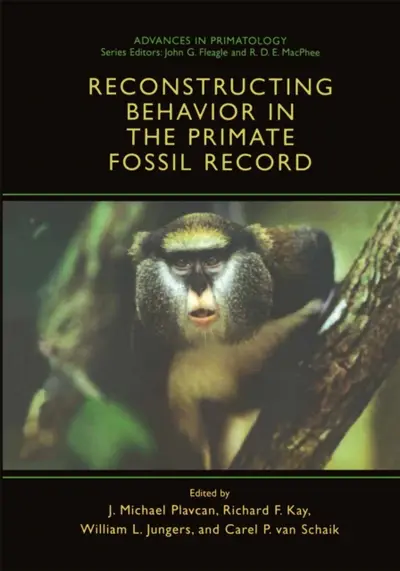
PDF · English
Reconstructing Behavior in the Primate Fossil Record
Price and availability
$175.99
Available in: Andorra, Austria, Australia, Belgium, Bulgaria, Canada, Switzerland, Cyprus, Czechia, Germany, Denmark, Estonia, Spain, Finland, France, United Kingdom, Guernsey, Greece, Croatia, Hungary, Ireland, Isle of Man, Iceland, Italy, Jersey, Japan, Liechtenstein, Lithuania, Luxembourg, Latvia, Monaco, Malta, Netherlands, Norway, Poland, Portugal, Romania, Sweden, Slovenia, Slovakia, San Marino, United States, Vatican City, South Africa
Stores: US, UK, Canada, EU, Australia.
Sign in to buyThe price is re-checked by the server before payment.
For personal use under the eBook licence.
- Format
- DRM
- Not stated by the publisher
- Language
- English
- Publisher
- Springer US
- Published
- 6 December 2012
- ISBN
- 9781461513438
- Subjects
- Anthropology, Evolution, Palaeontology, Anthropology, Evolution / Evolutionary biology, Palaeontology
About this book
This volume brings together a series of papers that address the topic of reconstructing behavior in the primate fossil record. The literature devoted to reconstructing behavior in extinct species is ovelWhelming and very diverse. Sometimes, it seems as though behavioral reconstruction is done as an afterthought in the discussion section of papers, relegated to the status of informed speculation. But recent years have seen an explosion in studies of adaptation, functional anatomy, comparative sociobiology, and development. Powerful new comparative methods are now available on the internet. At the same time, we face a rapidly growing fossil record that offers more and more information on the morphology and paleoenvironments of extinct species. Consequently, inferences of behavior in extinct species have become better grounded in comparative studies of living species and are becoming increas- ingly rigorous. We offer here a series of papers that review broad issues related to reconstructing various aspects of behavior from very different types of evi- dence. We hope that in so doing, the reader will gain a perspective on the various types of evidence that can be brought to bear on reconstructing behavior, the strengths and weaknesses of different approaches, and, perhaps, new approaches to the topic. We define behavior as broadly as we can- including life-history traits, locomotion, diet, and social behavior, giving the authors considerable freedom in choosing what, exactly, they wish to explore.
Bibliographic data © Gardners Books Ltd.