EPUB · English
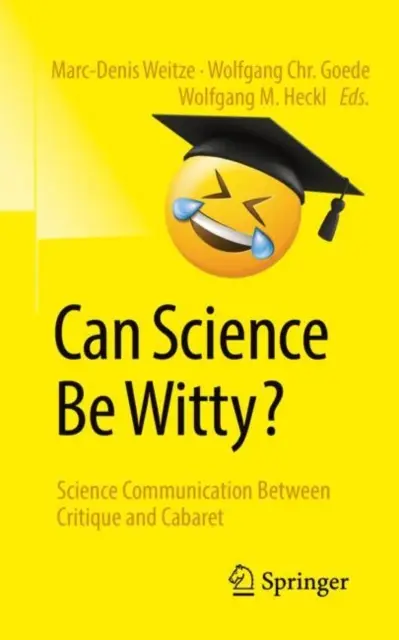
Can Science Be Witty?
Science Communication Between Critique and Cabaret
Price and availability
$40.99
Available in: Andorra, Austria, Australia, Belgium, Bulgaria, Canada, Switzerland, Cyprus, Czechia, Germany, Denmark, Estonia, Spain, Finland, France, United Kingdom, Guernsey, Greece, Croatia, Hungary, Ireland, Isle of Man, Iceland, Italy, Jersey, Japan, Liechtenstein, Lithuania, Luxembourg, Latvia, Monaco, Malta, Netherlands, Norway, Poland, Portugal, Romania, Sweden, Slovenia, Slovakia, San Marino, United States, Vatican City, South Africa
Stores: US, UK, Canada, EU, Australia.
Sign in to buyThe price is re-checked by the server before payment.
For personal use under the eBook licence.
- Format
- EPUB
- DRM
- Not stated by the publisher
- Language
- English
- Publisher
- Springer Berlin Heidelberg
- Published
- 1 February 2023
- ISBN
- 9783662657539
- Subjects
- Popular culture, Media studies, Physics, Biology, life sciences, Life sciences: general issues, Technology: general issues, Engineering: general, Popular culture, Media studies, Mathematics and Science, Life sciences: general issues, Engineering: general
About this book
"e;Can science be funny?"e; takes a close look at an element of modern science communication that is as innovative as it is promising for the future: comedy!Readers are guided through vividly presented academic theory as well as exciting hands-on and best practice examples from renowned practitioners and cabaret artists:- What do sheep's cheese and car tires have in common?- Can laughter break down walls?- How does "e;Die Anstalt"e; work?- How does magic create knowledge?- Is there humor in museums?- When a Dalmatian comes to the cash register- Three steps to humor- Serving suggestion for the Holy Spirit- dictatorship of stupidity- And much more!But it's not all just funny. Comedy can also take away some of the biting sharpness of criticism, making it digestible, even palatable, for the addressees."e;Can Science Be Funny?"e; navigates between criticism and cabaret, tackling comedy in various guises from different perspectives.22 contributions show how the results of science, research and technology can be brought to the general public in new ways. In particular, they also demonstrate how humour can be used as a critical and questioning force - valuable for all types of communication and helpful so that they come across more shrewdly in the future.The translation was done with the help of the artificial intelligence (machine translation by the service DeepL.com). The text has subsequently been revised further by the original editors in order to refine the work stylistically.
Bibliographic data © Gardners Books Ltd.