EPUB · English
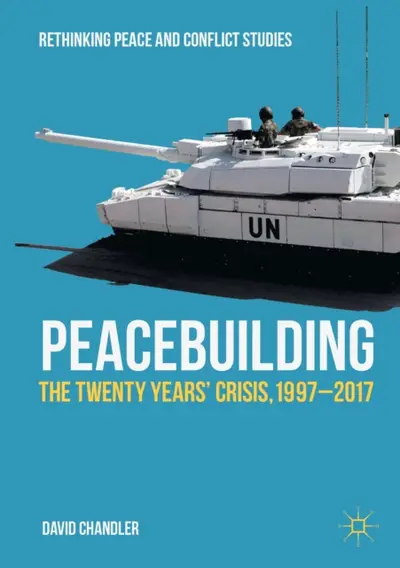
Peacebuilding
The Twenty Years’ Crisis, 1997-2017
Price and availability
$60.99
Available in: Andorra, Austria, Australia, Belgium, Bulgaria, Canada, Switzerland, Cyprus, Czechia, Germany, Denmark, Estonia, Spain, Finland, France, United Kingdom, Guernsey, Greece, Croatia, Hungary, Ireland, Isle of Man, Iceland, Italy, Jersey, Japan, Liechtenstein, Lithuania, Luxembourg, Latvia, Monaco, Malta, Netherlands, Norway, Poland, Portugal, Romania, Sweden, Slovenia, Slovakia, San Marino, United States, Vatican City, South Africa
Stores: US, UK, Canada, EU, Australia.
Sign in to buyThe price is re-checked by the server before payment.
For personal use under the eBook licence.
- Format
- EPUB
- DRM
- Not stated by the publisher
- Language
- English
- Publisher
- Springer International Publishing
- Published
- 29 March 2017
- ISBN
- 9783319503226
- Subjects
- c 1990 to c 2000, 21st century, Peace studies & conflict resolution, Political science & theory, International relations, Peace studies and conflict resolution, Political science and theory, History: specific events and topics
About this book
This book is the first to chart the rise and fall of peacebuilding. Charting its beginnings, as an ad-hoc extension of peacekeeping responsibilities, and formalisation, as a UN-supported international project of building liberal states. Twenty years later, the grounding policy assumptions of peacebuilding - that democracy, the rule of law and free markets were a universal solution to conflict-prone states and societies - have been revealed as naive at best, and at worst, hubristic and Eurocentric. Here, Chandler traces the disillusionment with international peacebuilding, and the discursive shifts in the self-understanding of the peacebuilding project in policy and academic debate. He charts the transformation from peacebuilding as an international project based on universalist assumptions, to the understanding of peace as a necessarily indigenous process based on plural and non-linear understandings of difference. Is the end of peacebuilding necessarily a cause for celebration? Does this shift result in a realist resignation to the world as it appears? Is it necessary to marry idealism with realism as E.H. Carr once argued - if we wish to keep open the possibilities for social change? This book seeks to answer these questions, making an invaluable reference both for students and practitioners of peacebuilding and for those interested in the broader shifts in the social and political grounding of policy-making today.
Bibliographic data © Gardners Books Ltd.