PDF · English
Revolutions in Development Inquiry
Price and availability
$51.99
Available in: Andorra, Austria, Australia, Belgium, Bulgaria, Canada, Switzerland, Cyprus, Czechia, Germany, Denmark, Estonia, Spain, Finland, France, United Kingdom, Guernsey, Greece, Croatia, Hungary, Ireland, Isle of Man, Iceland, Italy, Jersey, Japan, Liechtenstein, Lithuania, Luxembourg, Latvia, Monaco, Malta, Netherlands, Norway, Poland, Portugal, Romania, Sweden, Slovenia, Slovakia, San Marino, United States, Vatican City, South Africa
Stores: US, UK, Canada, EU, Australia.
Sign in to buyThe price is re-checked by the server before payment.
For personal use under the eBook licence.
- Format
- DRM
- Not stated by the publisher
- Language
- English
- Publisher
- Taylor & Francis
- Published
- 4 May 2012
- ISBN
- 9781136558122
- Subjects
- Development studies, Development economics & emerging economies, Applied ecology, Research methods / methodology, Development studies, Geographical information systems, geodata and remote sensing
About this book
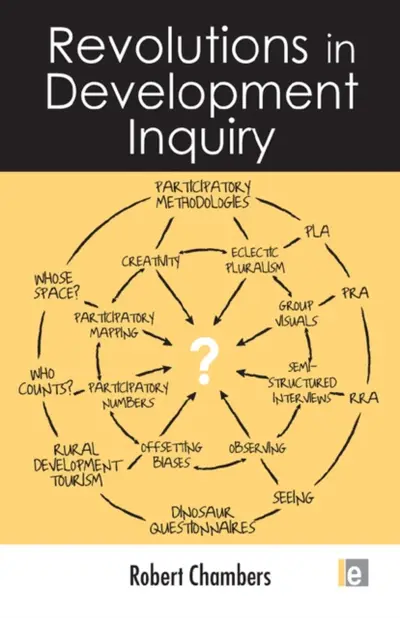
Robert Chambers returns with a new book that reviews, together for the first time, some of the revolutionary changes in the methodologies and methods of development inquiry that have occurred in the past forty years, and reflects on their transformative potential for the future. This book breaks new ground by describing and analysing the evolution of a sequence of approaches. Starting with the dinosaurs of large-scale multi-subject questionnaire surveys, and the biased visits and perceptions of rural development tourism and urban-based professionals, there follows a look at the explosive proliferation of methodologies and methods of recent years. These include rapid rural appraisal (RRA) participatory rural appraisal (PRA) and dramatic developments in the still largely unrecognized fields of participatory numbers and statistics, and of participatory mapping and GIS. Chambers shows how these can empower local people and provide rigorous and valid substitutes for some more traditional methods of inquiry. Also presented is a repertoire for offsetting the biases of the urban trap, which has become so serious for officials and aid agency staff. Importantly, Chambers points out that we are now in a different space, methodologically, from a few years ago. He makes the case that participatory methodologies, evolved through creative and eclectic pluralism, can be a transformative wave for the future as drivers of personal, professional and institutional change. This book is for all who are concerned with development, regardless of profession, discipline or organization, who seek to be abreast of the revolutionary breakthroughs in approaches and methods of inquiry of recent years, and what Chambers calls their 'unlimited potentials'. Published with IDS.
Bibliographic data © Gardners Books Ltd.