PDF · English
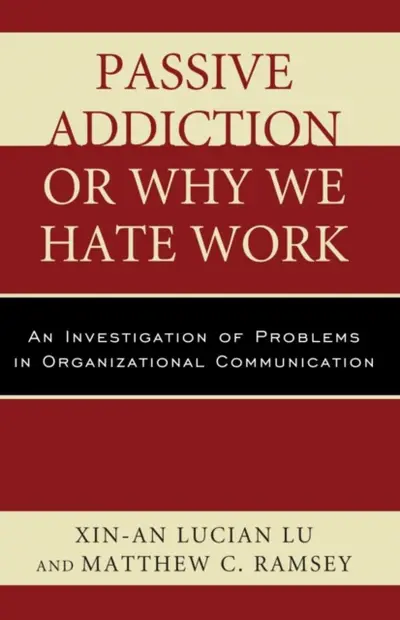
Passive Addiction or Why We Hate Work
An Investigation of Problems in Organizational Communication
Price and availability
$43.99
Available in: Andorra, Austria, Australia, Belgium, Bulgaria, Canada, Switzerland, Cyprus, Czechia, Germany, Denmark, Estonia, Spain, Finland, France, United Kingdom, Guernsey, Greece, Croatia, Hungary, Ireland, Isle of Man, Iceland, Italy, Jersey, Japan, Liechtenstein, Lithuania, Luxembourg, Latvia, Monaco, Malta, Netherlands, Norway, Poland, Portugal, Romania, Sweden, Slovenia, Slovakia, San Marino, United States, Vatican City, South Africa
Stores: US, UK, Canada, EU, Australia.
Sign in to buyThe price is re-checked by the server before payment.
For personal use under the eBook licence.
- Format
- DRM
- Not stated by the publisher
- Language
- English
- Publisher
- Bloomsbury Publishing (USA)
- Published
- 5 July 2013
- Pages
- 152
- ISBN
- 9780761861645
- Subjects
- Management & management techniques, Production & quality control management, Organizational theory & behaviour, Office management, Management and management techniques, Production and quality control management, Organizational theory and behaviour, Office management
About this book
This work examines various organizational problems that contribute to the phenomenon of passive addiction, problems so entrenched and quotidian that they no longer register in the organizational consciousness as problems. Passive addiction refers to the phenomenon in which the individual is addicted to various forms of passivity (e.g., procrastination, effortless and vacuous behaviors) as refuge from work one dislikes. Xin-An Lucian Lu and Matthew C. Ramsey investigate the dichotomization between work and life, ill-designed evaluation, the divorce between purpose and action, overemphasis of extrinsic order, the crisis of credibility, and the overuse of management over leadership. Technological and economic changes in the future may lead to the emergence of active addiction, a state of work that is blended with life and is actively embraced by the worker with a spirit of creativity and innovation.
Bibliographic data © Gardners Books Ltd.