PDF · English
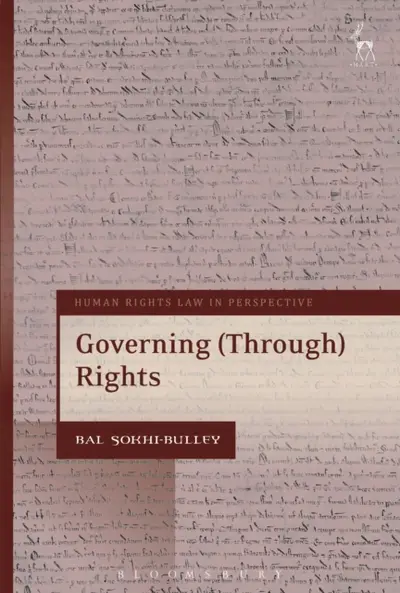
Governing (Through) Rights
Price and availability
$36.99
Available in: Andorra, Austria, Australia, Belgium, Bulgaria, Canada, Switzerland, Cyprus, Czechia, Germany, Denmark, Estonia, Spain, Finland, France, United Kingdom, Guernsey, Greece, Croatia, Hungary, Ireland, Isle of Man, Iceland, Italy, Jersey, Japan, Liechtenstein, Lithuania, Luxembourg, Latvia, Monaco, Malta, Netherlands, Norway, Poland, Portugal, Romania, Sweden, Slovenia, Slovakia, San Marino, United States, Vatican City, South Africa
Stores: US, UK, Canada, EU, Australia.
Sign in to buyThe price is re-checked by the server before payment.
For personal use under the eBook licence.
- Format
- DRM
- Not stated by the publisher
- Language
- English
- Publisher
- Bloomsbury Publishing
- Published
- 22 September 2016
- Pages
- 184
- ISBN
- 9781509903849
- Subjects
- Jurisprudence & philosophy of law, Comparative law, International human rights law, Human rights & civil liberties law, Methods, theory and philosophy of law, Comparative law, Public international law: human rights, Law: Human rights and civil liberties
About this book
Taking a critical attitude of dissatisfaction towards rights, the central premise of this book is that rights are technologies of governmentality. They are a regulating discourse that is itself managed through governing tactics and techniques hence governing (through) rights. Part I examines the 'problem of government' (through) rights. The opening chapter describes governmentality as a methodology that is then used to interrogate the relationship between rights and governance in three contexts: the international, regional and local. How rights regulate certain identities and conceptions of what is good governance is examined through the case study of non-state actors, specifically the NGO, in the international setting; through a case study of rights agencies, and the role of experts, indicators and the rights-based approach in the European Union or regional setting; and, in terms of the local, the challenge that the blossoming language of responsibility and community poses to rights in the name of less government (Big Society) is problematised. In Part II, on resisting government (through) rights, the book also asks what counter-conducts are possible using rights language (questioning rioting as resistance), and whether counter-conduct can be read as an ethos of the political, rights-bearing subject and as a new ethical right. Thus, the book bridges a divide between critical theory (ie Foucauldian understandings of power as governmentality) and human rights law.
Bibliographic data © Gardners Books Ltd.