PDF · English
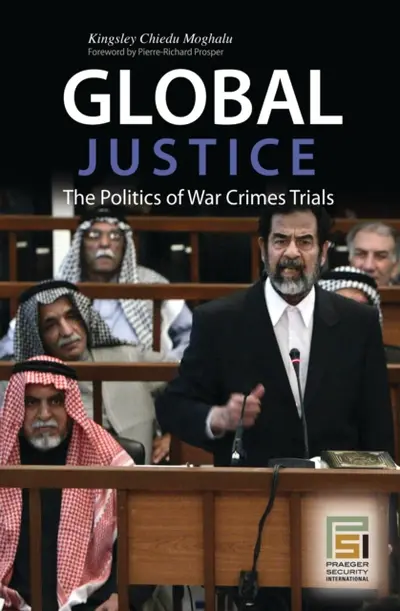
Global Justice
The Politics of War Crimes Trials
Price and availability
$60.99
Available in: Andorra, Austria, Australia, Belgium, Bulgaria, Canada, Switzerland, Cyprus, Czechia, Germany, Denmark, Estonia, Spain, Finland, France, United Kingdom, Guernsey, Greece, Croatia, Hungary, Ireland, Isle of Man, Iceland, Italy, Jersey, Japan, Liechtenstein, Lithuania, Luxembourg, Latvia, Monaco, Malta, Netherlands, Norway, Poland, Portugal, Romania, Sweden, Slovenia, Slovakia, San Marino, United States, Vatican City, South Africa
Stores: US, UK, Canada, EU, Australia.
Sign in to buyThe price is re-checked by the server before payment.
For personal use under the eBook licence.
- Format
- DRM
- Not stated by the publisher
- Language
- English
- Publisher
- Bloomsbury Publishing (USA)
- Published
- 30 October 2006
- Pages
- 240
- ISBN
- 9780313087127
- Subjects
- International humanitarian law, Public international law: humanitarian law
About this book
After a controversial war in which he was ousted and captured by United States forces, Saddam Hussein was arraigned before a war crimes tribunal. Slobodan Milosevic died midway through his contentious trial by an international war crimes tribunal at The Hague. Calls for intervention and war crimes trials for the massacres and rapes in Sudan's Darfur region have been loud and clear, and the United States remains fiercely opposed to the permanent International Criminal Court. Are war crimes trials impartial, apolitical forums? Has international justice for war crimes become an entrenched aspect of globalization? In Global Justice, Moghalu examines the phenomenon of war crimes trials from an unusual, political perspective-that of an anarchical international society.After a controversial war in which he was ousted and captured by United States forces, Saddam Hussein was arraigned before a war crimes tribunal. Slobodan Milosevic died midway through his contentious trial by an international war crimes tribunal at The Hague. Calls for intervention and war crimes trials for the massacres and rapes in Sudan's Darfur region have been loud and clear, and the United States remains fiercely opposed to the permanent International Criminal Court. Are war crimes trials impartial, apolitical forums? Has international justice for war crimes become an entrenched aspect of globalization?In Global Justice, Moghalu examines the phenomenon of war crimes trials from an unusual, political perspective-that of an anarchical international society. He argues that, contrary to conventional wisdom, war crimes trials are neither motivated nor influenced solely by abstract notions of justice. Instead, war crimes trials are the product of the interplay of political forces that have led to an inevitable clash between globalization and sovereignty on the sensitive question of who should judge war criminals. From Germany's Kaiser Wilhelm to the Japanese Emperor Hirohito, from the trials of Milosevic, Saddam Hussein, and Charles Taylor to Belgium's attempts to enforce the contested doctrine of universal jurisdiction, Moghalu renders a compelling tour de force of one of the most controversial subjects in world politics. He argues that, necessary though it was, international justice has run into a crisis of legitimacy. While international trials will remain a policy option, local or regional responses to mass atrocities will prove more durable.
Bibliographic data © Gardners Books Ltd.