EPUB · English
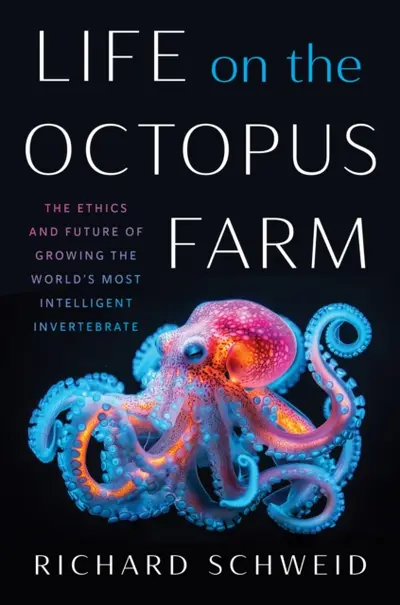
Life on the Octopus Farm
The Ethics and Future of Growing the World's Most Intelligent Invertebrate
- Society & social sciences
- Science & mathematics
- Nature, environment & geography
- Technology & engineering
Price and availability
$202.99
Available in: Andorra, Austria, Australia, Belgium, Bulgaria, Canada, Switzerland, Cyprus, Czechia, Germany, Denmark, Estonia, Spain, Finland, France, United Kingdom, Guernsey, Greece, Croatia, Hungary, Ireland, Isle of Man, Iceland, Italy, Jersey, Japan, Liechtenstein, Lithuania, Luxembourg, Latvia, Monaco, Malta, Netherlands, Norway, Poland, Portugal, Romania, Sweden, Slovenia, Slovakia, San Marino, United States, Vatican City, South Africa
Stores: US, UK, Canada, EU, Australia.
Sign in to buyThe price is re-checked by the server before payment.
For personal use under the eBook licence.
- Format
- EPUB
- DRM
- Not stated by the publisher
- Language
- English
- Publisher
- The University of North Carolina Press
- Published
- 11 August 2026
- ISBN
- 9781469696904
- Subjects
- Ethical issues & debates, Marine biology, Molluscs, Conservation of the environment, Aquaculture & fish-farming: practice & techniques, Conservation of the environment, Aquaculture and fish-farming
About this book
In 2021, the London School of Economics found that octopuses are sentient beings, capable of experiencing pain, distress, and happiness, and that high-welfare farming of them would therefore be impossible. But the enormous international demand for octopus meat continues to grow even as wild octopus populations decline, prompting a race to bring the first farm-raised product to market. At the same time, firestorms of protest in Europe and the United States over the ethics of farming such an intelligent creature are pressuring lawmakers to ban the practice altogether.After working at one of the worlds first octopus farms, on the Yucatn Peninsula, award-winning journalist Richard Schweid embarked on a global adventure to explore the ethics and future of octopus aquaculture. He traveled to octopus-farming sites in Mexico, Spain, and Japan where he met people on both sides of the ethical debate: marine biologists, businesspeople, restaurateurs, animal rights advocates, octopus farmers, and everyday fishermen whose livelihoods depend on wild octopus. In this vibrant account of his experiences, Schweid also engages pressing related issues: environmental impact; the need for sustainable farming opportunities in underresourced communities; and how global desires for specific foods place pressure on local populations. Ultimately, the appetite for octopus demonstrates the conundrums of our interconnected worldacross countries, through oceans, and via the food we consume.
Bibliographic data © Gardners Books Ltd.