EPUB · English
Intersectional Listening
Gentrification and Black Sonic Life in Washington, DC
Price and availability
$22.99
Available in: Andorra, Austria, Australia, Belgium, Bulgaria, Canada, Switzerland, Cyprus, Czechia, Germany, Denmark, Estonia, Spain, Finland, France, United Kingdom, Guernsey, Greece, Croatia, Hungary, Ireland, Isle of Man, Iceland, Italy, Jersey, Japan, Liechtenstein, Lithuania, Luxembourg, Latvia, Monaco, Malta, Netherlands, Norway, Poland, Portugal, Romania, Sweden, Slovenia, Slovakia, San Marino, United States, Vatican City, South Africa
Stores: US, UK, Canada, EU, Australia.
Sign in to buyThe price is re-checked by the server before payment.
For personal use under the eBook licence.
- Format
- EPUB
- DRM
- Not stated by the publisher
- Language
- English
- Publisher
- Oxford University Press
- Published
- 25 February 2025
- ISBN
- 9780197671597
- Subjects
- USA, District of Columbia (Washington, DC), Theory of music & musicology, Non-Western music: traditional & "classical", Urban communities, United States of America, USA, 1KBB-US-SEC, Theory of music and musicology, AVLA, JBSD
About this book
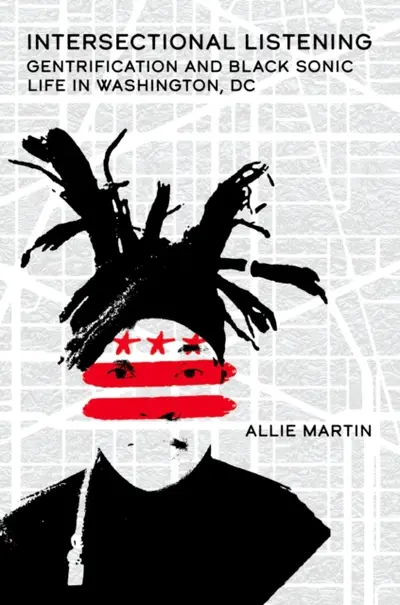
Gentrification is often considered through a visual lens, where development, progress, and neighborhood change are observed. But what does gentrification sound like? In Intersectional Listening, author Allie Martin engages this question in Washington, DC, asking how Black people experience gentrification as a sonic, racialized process. Drawing from music, interviews, soundscape recordings, and more, Martin argues that gentrification ultimately serves to silence some voices and amplify others. Martin employs a combination of methodologies from ethnomusicology, Black Studies, geography, and digital humanities to make audible the ways in which gentrification disrupts and disturbs community. Throughout, she centers Black feminist listening practices, thinking through digital modes of listening and imagining emancipatory soundscapes. Intersectional Listening benefits from an innovative combination of sources, from interviews and soundwalks to passive acoustic recording and machine learning. Martin shares compelling stories of music and sound in the nation's capital, and in doing so shifts conversations about how we listen to Black life. By foregrounding how processes of gentrification systematically seek to devalue, mishear, and ultimately silence Black possibility, Intersectional Listening posits how we can challenge ourselves to refute the consistent mishearing of Black people in Washington, DC and beyond.
Bibliographic data © Gardners Books Ltd.