PDF · English
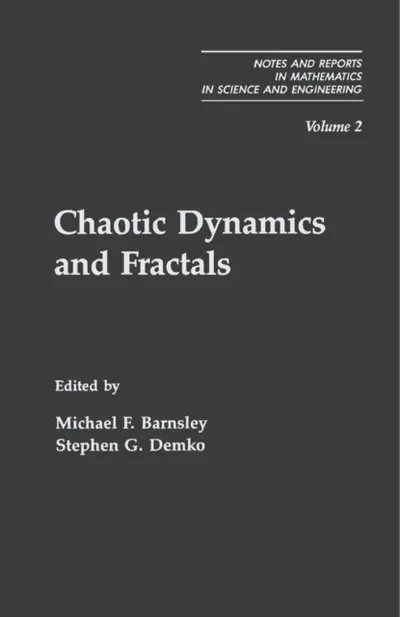
Chaotic Dynamics and Fractals
Price and availability
$59.99
Available in: Andorra, Austria, Australia, Belgium, Bulgaria, Canada, Switzerland, Cyprus, Czechia, Germany, Denmark, Estonia, Spain, Finland, France, United Kingdom, Guernsey, Greece, Croatia, Hungary, Ireland, Isle of Man, Iceland, Italy, Jersey, Japan, Liechtenstein, Lithuania, Luxembourg, Latvia, Monaco, Malta, Netherlands, Norway, Poland, Portugal, Romania, Sweden, Slovenia, Slovakia, San Marino, United States, Vatican City, South Africa
Stores: US, UK, Canada, EU, Australia.
Sign in to buyThe price is re-checked by the server before payment.
For personal use under the eBook licence.
- Format
- DRM
- Not stated by the publisher
- Language
- English
- Publisher
- Elsevier Science
- Published
- 10 May 2014
- ISBN
- 9781483269085
- Subjects
- Calculus & mathematical analysis, Calculus, Calculus and mathematical analysis, Calculus
About this book
Chaotic Dynamics and Fractals covers the proceedings of the 1985 Conference on Chaotic Dynamics, held at the Georgia Institute of Technology. This conference deals with the research area of chaos, dynamical systems, and fractal geometry. This text is organized into three parts encompassing 16 chapters. The first part describes the nature of chaos and fractals, the geometric tool for some strange attractors, and other complicated sets of data associated with chaotic systems. This part also considers the Henon-Hiles Hamiltonian with complex time, a Henon family of maps from C2 into itself, and the idea of turbulent maps in the course of presenting results on iteration of continuous maps from the unit interval to itself. The second part discusses complex analytic dynamics and associated fractal geometry, specifically the bursts into chaos, algorithms for obtaining geometrical and combinatorial information, and the parameter space for iterated cubic polynomials. This part also examines the differentiation of Julia sets with respects to a parameter in the associated rational map, permitting the formulation of Taylor series expansion for the sets. The third part highlights the applications of chaotic dynamics and fractals. This book will prove useful to mathematicians, physicists, and other scientists working in, or introducing themselves to, the field.
Bibliographic data © Gardners Books Ltd.