PDF · English
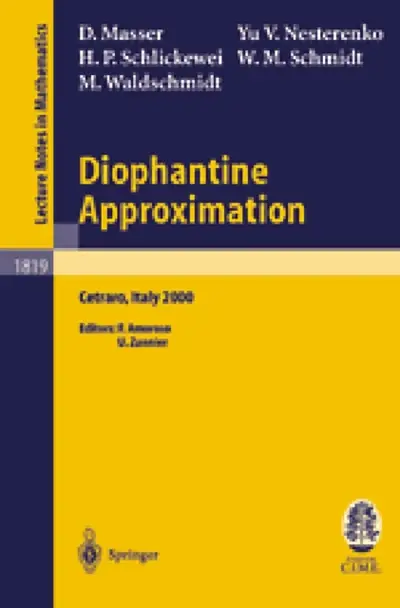
Diophantine Approximation
Lectures given at the C.I.M.E. Summer School held in Cetraro, Italy, June 28 – July 6, 2000
Price and availability
$60.99
Available in: Andorra, Austria, Australia, Belgium, Bulgaria, Canada, Switzerland, Cyprus, Czechia, Germany, Denmark, Estonia, Spain, Finland, France, United Kingdom, Guernsey, Greece, Croatia, Hungary, Ireland, Isle of Man, Iceland, Italy, Jersey, Japan, Liechtenstein, Lithuania, Luxembourg, Latvia, Monaco, Malta, Netherlands, Norway, Poland, Portugal, Romania, Sweden, Slovenia, Slovakia, San Marino, United States, Vatican City, South Africa
Stores: US, UK, Canada, EU, Australia.
Sign in to buyThe price is re-checked by the server before payment.
For personal use under the eBook licence.
- Format
- DRM
- Not stated by the publisher
- Language
- English
- Publisher
- Springer Berlin Heidelberg
- Published
- 1 February 2008
- ISBN
- 9783540449799
- Subjects
- Mathematics & science, Number theory, Number theory
About this book
Diophantine Approximation is a branch of Number Theory having its origins intheproblemofproducing"e;best"e;rationalapproximationstogivenrealn- bers. Since the early work of Lagrange on Pell's equation and the pioneering work of Thue on the rational approximations to algebraic numbers of degree ? 3, it has been clear how, in addition to its own speci?c importance and - terest, the theory can have fundamental applications to classical diophantine problems in Number Theory. During the whole 20th century, until very recent times, this fruitful interplay went much further, also involving Transcend- tal Number Theory and leading to the solution of several central conjectures on diophantine equations and class number, and to other important achie- ments. These developments naturally raised further intensive research, so at the moment the subject is a most lively one. This motivated our proposal for a C. I. M. E. session, with the aim to make it available to a public wider than specialists an overview of the subject, with special emphasis on modern advances and techniques. Our project was kindly supported by the C. I. M. E. Committee and met with the interest of a largenumberofapplicants;forty-twoparticipantsfromseveralcountries,both graduatestudentsandseniormathematicians,intensivelyfollowedcoursesand seminars in a friendly and co-operative atmosphere. The main part of the session was arranged in four six-hours courses by Professors D. Masser (Basel), H. P. Schlickewei (Marburg), W. M. Schmidt (Boulder) and M. Waldschmidt (Paris VI). This volume contains expanded notes by the authors of the four courses, together with a paper by Professor Yu. V.
Bibliographic data © Gardners Books Ltd.