PDF · English
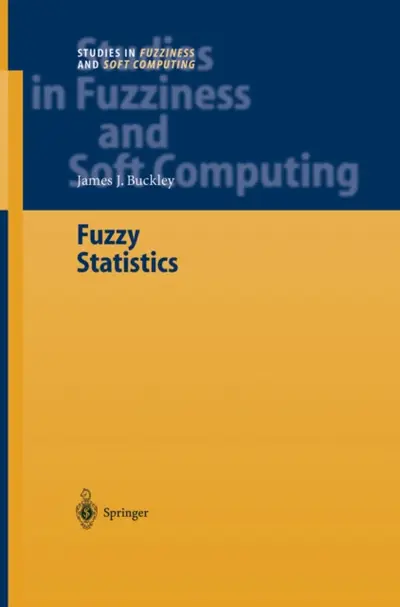
Fuzzy Statistics
Price and availability
$120.99
Available in: Andorra, Austria, Australia, Belgium, Bulgaria, Canada, Switzerland, Cyprus, Czechia, Germany, Denmark, Estonia, Spain, Finland, France, United Kingdom, Guernsey, Greece, Croatia, Hungary, Ireland, Isle of Man, Iceland, Italy, Jersey, Japan, Liechtenstein, Lithuania, Luxembourg, Latvia, Monaco, Malta, Netherlands, Norway, Poland, Portugal, Romania, Sweden, Slovenia, Slovakia, San Marino, United States, Vatican City, South Africa
Stores: US, UK, Canada, EU, Australia.
Sign in to buyThe price is re-checked by the server before payment.
For personal use under the eBook licence.
- Format
- DRM
- Not stated by the publisher
- Language
- English
- Publisher
- Springer Berlin Heidelberg
- Published
- 11 November 2013
- ISBN
- 9783540399193
- Subjects
- Cybernetics & systems theory, Probability & statistics, Applied mathematics, Technology: general issues, Engineering: general, Artificial intelligence, Cybernetics and systems theory, Probability and statistics, Stochastics, Engineering: general, Maths for engineers, Artificial intelligence (AI)
About this book
1. 1 Introduction This book is written in four major divisions. The first part is the introductory chapters consisting of Chapters 1 and 2. In part two, Chapters 3-11, we develop fuzzy estimation. For example, in Chapter 3 we construct a fuzzy estimator for the mean of a normal distribution assuming the variance is known. More details on fuzzy estimation are in Chapter 3 and then after Chapter 3, Chapters 4-11 can be read independently. Part three, Chapters 12- 20, are on fuzzy hypothesis testing. For example, in Chapter 12 we consider the test Ho : /1 = /10 verses HI : /1 f=- /10 where /1 is the mean of a normal distribution with known variance, but we use a fuzzy number (from Chapter 3) estimator of /1 in the test statistic. More details on fuzzy hypothesis testing are in Chapter 12 and then after Chapter 12 Chapters 13-20 may be read independently. Part four, Chapters 21-27, are on fuzzy regression and fuzzy prediction. We start with fuzzy correlation in Chapter 21. Simple linear regression is the topic in Chapters 22-24 and Chapters 25-27 concentrate on multiple linear regression. Part two (fuzzy estimation) is used in Chapters 22 and 25; and part 3 (fuzzy hypothesis testing) is employed in Chapters 24 and 27. Fuzzy prediction is contained in Chapters 23 and 26. A most important part of our models in fuzzy statistics is that we always start with a random sample producing crisp (non-fuzzy) data.
Bibliographic data © Gardners Books Ltd.