PDF · English
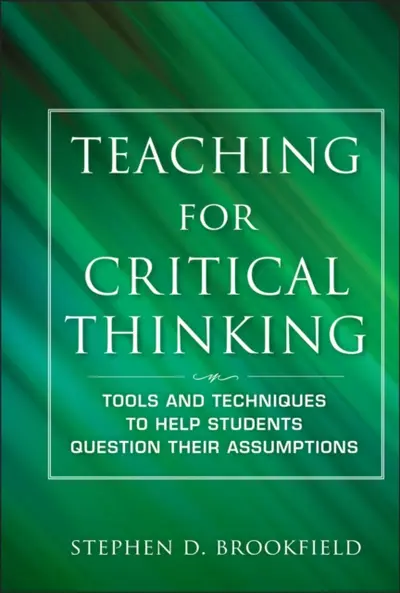
Teaching for Critical Thinking
Tools and Techniques to Help Students Question Their Assumptions
Price and availability
$45.99
Available in: Andorra, Austria, Australia, Belgium, Bulgaria, Canada, Switzerland, Cyprus, Czechia, Germany, Denmark, Estonia, Spain, Finland, France, United Kingdom, Guernsey, Greece, Croatia, Hungary, Ireland, Isle of Man, Iceland, Italy, Jersey, Japan, Liechtenstein, Lithuania, Luxembourg, Latvia, Monaco, Malta, Netherlands, Norway, Poland, Portugal, Romania, Sweden, Slovenia, Slovakia, San Marino, United States, Vatican City, South Africa
Stores: US, UK, Canada, EU, Australia.
Sign in to buyThe price is re-checked by the server before payment.
For personal use under the eBook licence.
- Format
- DRM
- Not stated by the publisher
- Language
- English
- Publisher
- Wiley
- Published
- 18 October 2011
- ISBN
- 9781118146705
- Subjects
- Philosophy: logic, Education, Study & learning skills: general, Education / Educational sciences / Pedagogy, Study and learning skills: general, QDTL
About this book
While notions of what constitutes critical thinking vary, educators, politicians, and employers all agree that critical thinking skills are necessary for well-educated citizens and a key capacity for successful employees. In Teaching for Critical Thinking, Stephen Brookfield explores how students learn to think critically and what methods teachers can use to help. In his engaging, conversational style, Brookfield establishes a basic protocol of critical thinking that focuses on students uncovering and checking assumptions, exploring alternative perspectives, and taking informed actions. The book fosters a shared understanding of critical thinking and helps all faculty adapt general principles to specific disciplinary contexts. Drawing on thousands of student testimonies, the book identifies the teaching methods and approaches that are most successful when teaching students to think, read, and write critically. Brookfield explains when to make critical thinking the classroom focus, how to encourage critical discussions, and ways to reach skeptical students. He outlines the basic components required when reviewing a text critically and shows how to give highly specific feedback. The book also addresses how to foster critical thinking across an institution, beginning with how it can be explained in syllabi and even integrated into strategic plans and institutional missions. Brookfield stresses the importance of teachers modeling critical thinking and demonstrates himself how to do this. Crammed with activities and techniques, this how-to guide is applicable in face-to-face, online, and hybrid classrooms of all sizes. Each exercise includes detailed instructions, examples from different academic disciplines, and guidance for when and how to best use each activity. Any reader will come away with a pedagogic tool kit of new ideas for classroom exercises, new approaches to designing course assignments, and new ways to assess students ability to practice critical analysis.
Bibliographic data © Gardners Books Ltd.