PDF · English
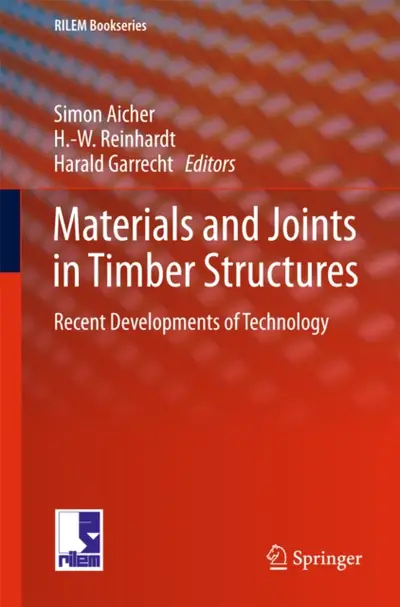
Materials and Joints in Timber Structures
Recent Developments of Technology
Price and availability
$377.99
Available in: Andorra, Austria, Australia, Belgium, Bulgaria, Canada, Switzerland, Cyprus, Czechia, Germany, Denmark, Estonia, Spain, Finland, France, United Kingdom, Guernsey, Greece, Croatia, Hungary, Ireland, Isle of Man, Iceland, Italy, Jersey, Japan, Liechtenstein, Lithuania, Luxembourg, Latvia, Monaco, Malta, Netherlands, Norway, Poland, Portugal, Romania, Sweden, Slovenia, Slovakia, San Marino, United States, Vatican City, South Africa
Stores: US, UK, Canada, EU, Australia.
Sign in to buyThe price is re-checked by the server before payment.
For personal use under the eBook licence.
- Format
- DRM
- Not stated by the publisher
- Language
- English
- Publisher
- Springer Netherlands
- Published
- 25 September 2013
- ISBN
- 9789400778115
- Subjects
- Technical design, Materials science, Civil engineering, surveying & building, Building construction & materials, Technical design, Materials science, Building construction and materials
About this book
This book contains the contributions from the RILEM International Symposium on Materials and Joints in Timber Structures that was held in Stuttgart, Germany from October 8 to 10, 2013. It covers recent developments in the materials and the joints used in modern timber structures. Regarding basic wooden materials, the contributions highlight the widened spectrum of products comprising cross-laminated timber, glulam and LVL from hardwoods and block glued elements. Timber concrete compounds, cement bonded wood composites and innovative light-weight constructions represent increasingly employed alternatives for floors, bridges and facades. With regard to jointing technologies, considerable advances in both mechanical connections and glued joints are presented. Self-tapping screws have created unprecedented options for reliable, strong as well as ductile joints and reinforcement technologies. Regarding adhesives, which constitute the basis of the jointing/laminating technology of modern timber products, extended options for tailor-made bonding solutions have to be stated. Apart from melamine-urea and phenolic-resorcinol adhesives, one-component-polyurethanes, emulsion isocyanate polymers and epoxies offer a wide range of possibilities. The contributions dealing with experimental and numerical investigations on static, cyclic and seismic behavior of structures clearly reveal the enhanced potential of modern timber construction for reliable and sustainable buildings and bridges of the new millennium.The book is structured in nine thematic areas, beingI) StructuresII) Mechanical ConnectionsIII) Glued Joints and AdhesivesIV) Timber and Concrete/Cement/Polymer CompositesV) Cyclic, Seismic BehaviorVI) Hardwood, Modified Wood and BambooVII) Cross-Laminated TimberVIII) Properties and Testing of WoodIX) Glulam
Bibliographic data © Gardners Books Ltd.