PDF · English
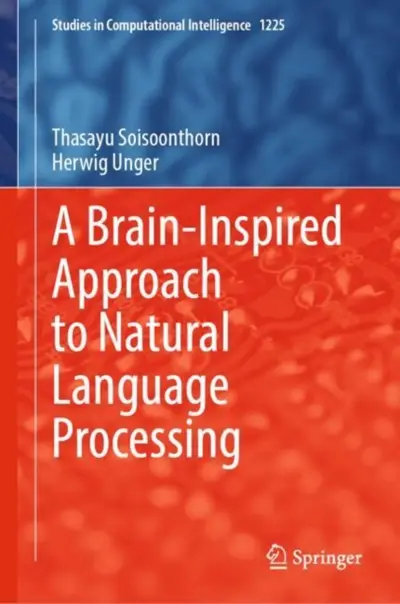
Brain-Inspired Approach to Natural Language Processing
Price and availability
$175.99
Available in: Andorra, Austria, Australia, Belgium, Bulgaria, Canada, Switzerland, Cyprus, Czechia, Germany, Denmark, Estonia, Spain, Finland, France, United Kingdom, Guernsey, Greece, Croatia, Hungary, Ireland, Isle of Man, Iceland, Italy, Jersey, Japan, Liechtenstein, Lithuania, Luxembourg, Latvia, Monaco, Malta, Netherlands, Norway, Poland, Portugal, Romania, Sweden, Slovenia, Slovakia, San Marino, United States, Vatican City, South Africa
Stores: US, UK, Canada, EU, Australia.
Sign in to buyThe price is re-checked by the server before payment.
For personal use under the eBook licence.
- Format
- DRM
- Not stated by the publisher
- Language
- English
- Publisher
- Springer Nature Switzerland
- Published
- 14 October 2025
- ISBN
- 9783032000149
- Subjects
- Engineering: general, Artificial intelligence, Natural language & machine translation, Audio processing, Artificial intelligence (AI), Natural language and machine translation
About this book
This book brings together key ideas from neuroscience and artificial intelligence to show how they can work together. It helps readers understand how studying the brain can lead to more adaptable and efficient AI systems. Instead of treating the two fields as separate, it highlights how brain-inspired models can help overcome current challenges in AI, improve existing techniques, and spark new and creative solutions.The journey begins with the biological foundations of intelligence, focusing on the brain’s structure, evolution, and functions, particularly the neocortex, which plays a central role in learning and prediction. Building on this foundation, the book surveys both traditional and modern AI methods in an accessible way and offers a critical analysis of their strengths and shortcomings. The discussion then moves from theory to practice, showing how brain-inspired ideas can be applied to real-world Natural Language Processing (NLP) tasks such as spelling correction and Thai word segmentation, where conventional models often struggle with nuance and complexity. In its final sections, the book reflects on the broader significance of integrating neuroscience and AI, encouraging continued exploration and innovation at the intersection of these disciplines.Key benefits of this book include:- Exploring biologically plausible models of intelligence to open new pathways- Gaining foundational insights into how neuroscience can inform AI design- Presenting practical examples to enhance NLP tasks in complex languages- Offering a testbed for experimentation with brain-inspired computational models- Serving as a valuable resource for advanced students, researchers, and professionals seeking to deepen their understanding of nature-inspired intelligent systemsWhile refining existing AI models may lead to meaningful progress, it remains uncertain whether such approaches alone can achieve a deeper form of intelligence. By contrast, drawing inspiration from the structure and function of the human brain may offer a promising direction toward creating systems that are more flexible, adaptive, and capable of exhibiting human-like behavior.
Bibliographic data © Gardners Books Ltd.