EPUB · English
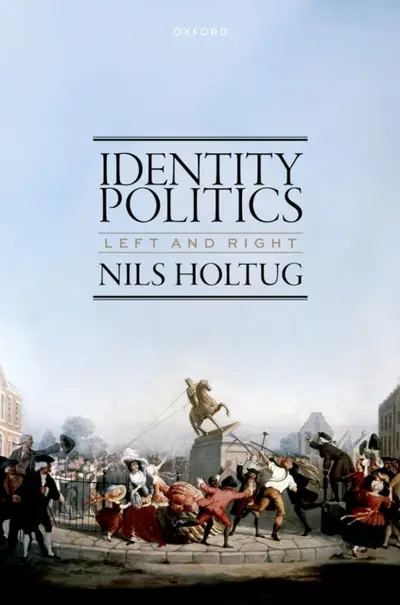
Identity Politics
Left and Right
Price and availability
$83.99
Available in: Andorra, Austria, Australia, Belgium, Bulgaria, Canada, Switzerland, Cyprus, Czechia, Germany, Denmark, Estonia, Spain, Finland, France, United Kingdom, Guernsey, Greece, Croatia, Hungary, Ireland, Isle of Man, Iceland, Italy, Jersey, Japan, Liechtenstein, Lithuania, Luxembourg, Latvia, Monaco, Malta, Netherlands, Norway, Poland, Portugal, Romania, Sweden, Slovenia, Slovakia, San Marino, United States, Vatican City, South Africa
Stores: US, UK, Canada, EU, Australia.
Sign in to buyThe price is re-checked by the server before payment.
For personal use under the eBook licence.
- Format
- EPUB
- DRM
- Not stated by the publisher
- Language
- English
- Publisher
- Oxford University Press
- Published
- 12 March 2025
- ISBN
- 9780198954545
- Subjects
- Social & political philosophy, Popular philosophy, Social issues & processes, Political correctness, Political science & theory, Social attitudes, Political science and theory, Social and political philosophy, Popular philosophy
About this book
According to a common narrative, identity politics derives from leftist postmodernism, and is antithetical to both liberalism and Enlightenment universalism. This narrative, however, is false. Identity politics is propagated not only by the left but also by the right-and it is not tied to postmodernism. Various forms of identity politics are, in fact, quite compatible with liberalism and Enlightenment values. Based on a liberal egalitarian framework, Nils Holtug argues that some forms of identity politics are well worth pursuing, while others should clearly be resisted. Among other things, identity politics can serve to increase the opportunities of worse off, marginalized groups. In this book, Holtug considers and assesses specific identity policies, including affirmative action for African Americans, opposition to the n-word and blackfacing, and the backlash against cultural appropriation and out-group representation in art. Identity Politics surveys various forms of 'cancel culture', such as no platforming and the pulling down of statues depicting morally compromised historical figures. Holtug also scrutinizes instances that are more specific to the political right, including white supremacism and ethnopluralism. Finally, he considers the suggestion that identity politics is divisive and drives down social solidarity, arguing that while some forms of identity politics do indeed drive down solidarity, this is less clear in the case of the minority-accommodating policies.
Bibliographic data © Gardners Books Ltd.