EPUB · English
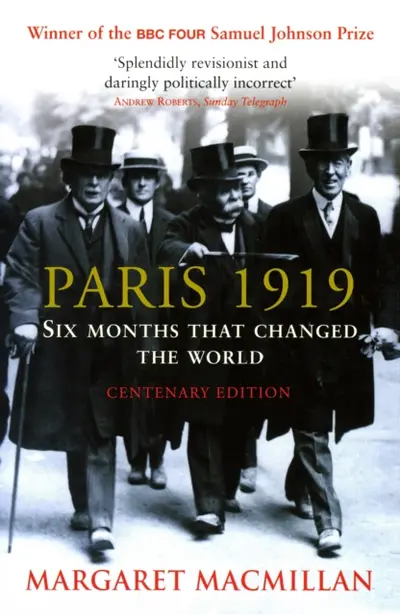
Paris 1919
Six Months that Changed the World
Price and availability
Not sold in this region
Available in: Andorra, Austria, Australia, Belgium, Bulgaria, Switzerland, Cyprus, Czechia, Germany, Denmark, Estonia, Spain, Finland, France, United Kingdom, Guernsey, Greece, Croatia, Hungary, Ireland, Isle of Man, Iceland, Italy, Jersey, Japan, Liechtenstein, Lithuania, Luxembourg, Latvia, Monaco, Malta, Netherlands, Norway, Poland, Portugal, Romania, Sweden, Slovenia, Slovakia, San Marino, Vatican City, South Africa
Stores: UK, EU, Australia. Not available in the United States store.
This title cannot be bought in this store yet: its supplier terms, territorial rights or price are still being confirmed.
For personal use under the eBook licence.
- Format
- EPUB
- DRM
- Not stated by the publisher
- Language
- English
- Publisher
- John Murray Press
- Published
- 10 November 2011
- ISBN
- 9781848546684
- Subjects
- France, c 1918 to c 1939 (Inter-war period), Peace studies & conflict resolution, European history, 20th century history: c 1900 to c 2000, France, European history
About this book
Previously published as PeacemakersBetween January and July 1919, after the war to end all wars, men and women from all over the world converged on Paris for the Peace Conference. At its heart were the leaders of the three great powers - Woodrow Wilson, Lloyd George and Clemenceau. Kings, prime ministers and foreign ministers with their crowds of advisers rubbed shoulders with journalists and lobbyists for a hundred causes - from Armenian independence to women's rights. Everyone had business in Paris that year - T.E. Lawrence, Queen Marie of Romania, Maynard Keynes, Ho Chi Minh. There had never been anything like it before, and there never has been since.For six extraordinary months the city was effectively the centre of world government as the peacemakers wound up bankrupt empires and created new countries. They pushed Russia to the sidelines, alienated China and dismissed the Arabs, struggled with the problems of Kosovo, of the Kurds, and of a homeland for the Jews.The peacemakers, so it has been said, failed dismally; failed above all to prevent another war. Margaret MacMillan argues that they have unfairly been made scapegoats for the mistakes of those who came later. They tried to be evenhanded, but their goals - to make defeated countries pay without destroying them, to satisfy impossible nationalist dreams, to prevent the spread of Bolshevism and to establish a world order based on democracy and reason - could not be achieved by diplomacy. Paris 1919 (originally published as Peacemakers) offers a prismatic view of the moment when much of the modern world was first sketched out.
Bibliographic data © Gardners Books Ltd.