PDF · English
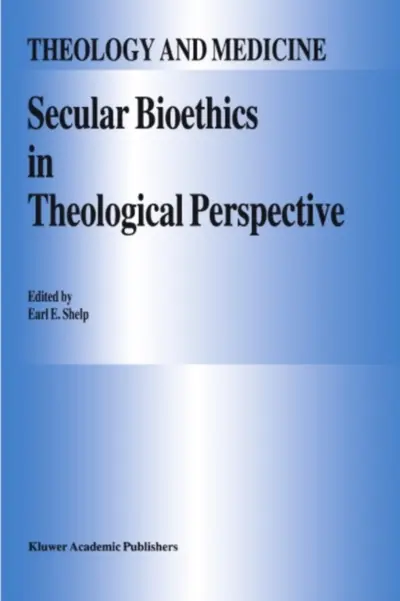
Secular Bioethics in Theological Perspective
Price and availability
$120.99
Available in: Andorra, Austria, Australia, Belgium, Bulgaria, Canada, Switzerland, Cyprus, Czechia, Germany, Denmark, Estonia, Spain, Finland, France, United Kingdom, Guernsey, Greece, Croatia, Hungary, Ireland, Isle of Man, Iceland, Italy, Jersey, Japan, Liechtenstein, Lithuania, Luxembourg, Latvia, Monaco, Malta, Netherlands, Norway, Poland, Portugal, Romania, Sweden, Slovenia, Slovakia, San Marino, United States, Vatican City, South Africa
Stores: US, UK, Canada, EU, Australia.
Sign in to buyThe price is re-checked by the server before payment.
For personal use under the eBook licence.
- Format
- DRM
- Not stated by the publisher
- Language
- English
- Publisher
- Springer Netherlands
- Published
- 6 December 2012
- ISBN
- 9789400901193
- Subjects
- Philosophy, Ethics & moral philosophy, Religion: general, Medical ethics & professional conduct, Life sciences: general issues, Bio-ethics, Medical ethics and professional conduct, Life sciences: general issues, Bioethics, Philosophy, Ethics and moral philosophy, Religion: general
About this book
Theologians and theologically educated participants in discussions of bioethics have been placed on the defensive during recent years. The dominance of religious perspectives and theological voices that marked the emergence and establishment of "e;bioethics"e; in the late 1960s and 1970s has eroded steadily as philosophers, lawyers, and others have relativized their role and influ- ence, at best, or dismissed it entirely, at worst. The secularization of bioethics, which has occurred for a variety of reasons, has prompted some prominent writers to reflect on what has been lost. Daniel Callahan, for example writes, "e; . . . whatever the ultimate truth status of religious perspectives, they have provided a way of looking at the world and understanding one's own life that has a fecundity and uniqueness not matched by philosophy, law, or political theory. Those of us who have lost our reli- gious faith may be glad that we have discovered what we take to be the reality of things, but we can still recognize that we have also lost something of great value as well: the faith, vision, insights, and experience of whole peoples and traditions who, no less than we unbelievers, struggled to make sense of things. That those goods are part of a garment we no longer want to wear does not make their loss anything other than still a loss; and it is not a neglible one"e; ([2], p. 2).
Bibliographic data © Gardners Books Ltd.