PDF · English
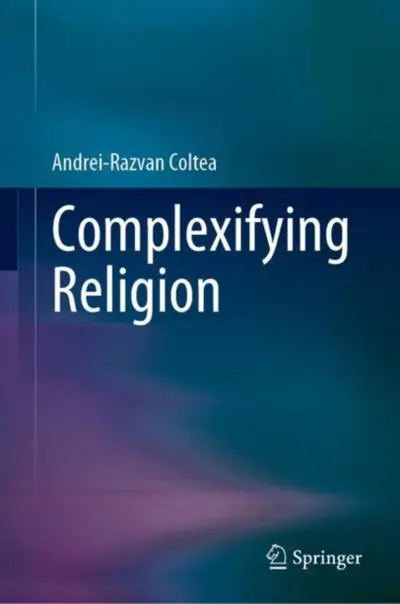
Complexifying Religion
Price and availability
$148.99
Available in: Andorra, Austria, Australia, Belgium, Bulgaria, Canada, Switzerland, Cyprus, Czechia, Germany, Denmark, Estonia, Spain, Finland, France, United Kingdom, Guernsey, Greece, Croatia, Hungary, Ireland, Isle of Man, Iceland, Italy, Jersey, Japan, Liechtenstein, Lithuania, Luxembourg, Latvia, Monaco, Malta, Netherlands, Norway, Poland, Portugal, Romania, Sweden, Slovenia, Slovakia, San Marino, United States, Vatican City, South Africa
Stores: US, UK, Canada, EU, Australia.
Sign in to buyThe price is re-checked by the server before payment.
For personal use under the eBook licence.
- Format
- DRM
- Not stated by the publisher
- Language
- English
- Publisher
- Springer Nature Singapore
- Published
- 31 July 2023
- ISBN
- 9789819947010
- Subjects
- Philosophy, Religion & science, History of ideas, Philosophical traditions and schools of thought, Religion and science
About this book
This book provides an original and challenging perspective of religions as abstract complex adaptive systems, using an interdisciplinary approach to try to understand what religions are and how they function, two fundamental issues which, despite an intense struggle from several fields, have not yet been resolved. What is the source of religious belief? How do religions work and what are they made of? Why is religion so important for us that it has survived centuries of scientific progress and secularization? Why are people religious even outside religion? The book addresses these questions using an interdisciplinary approach that seeks to untangle the Gordian knot of defining religion. In short, they can be considered entropy-reducing technologies. What differentiates them from other meaning-producing systems is their configuration which employs specific building blocks as tools for mitigating entropy, which are also subsystems and combine in various ways to build a unique configuration: rituals, myths, taboos, supernatural agents, authority, identity, superstitions, moral obligations, afterlife beliefs and the sacred. As a reaction to perturbances or pressure, systems can collapse. Inspired by Nicholas Nassim Taleb, it is, in this book, referred to as fragility-the negative reaction of systems to random events, and four parameters can be used to evaluate it in religious systems: monotonicity (the inability to learn from past mistakes), coupling (linking with other systems: such as political or economic), centralization and stress starvation. Several case studies are provided in order to test the theoretical claims made in this book, based on the author's field research in Romania, Japan, North Korea and Mongolia, and offering details that could be of interest to casual readers, students and researchers of religion.
Bibliographic data © Gardners Books Ltd.