PDF · English
Modeling from Reality
Price and availability
$120.99
Available in: Andorra, Austria, Australia, Belgium, Bulgaria, Canada, Switzerland, Cyprus, Czechia, Germany, Denmark, Estonia, Spain, Finland, France, United Kingdom, Guernsey, Greece, Croatia, Hungary, Ireland, Isle of Man, Iceland, Italy, Jersey, Japan, Liechtenstein, Lithuania, Luxembourg, Latvia, Monaco, Malta, Netherlands, Norway, Poland, Portugal, Romania, Sweden, Slovenia, Slovakia, San Marino, United States, Vatican City, South Africa
Stores: US, UK, Canada, EU, Australia.
Sign in to buyThe price is re-checked by the server before payment.
For personal use under the eBook licence.
- Format
- DRM
- Not stated by the publisher
- Language
- English
- Publisher
- Springer US
- Published
- 6 December 2012
- ISBN
- 9781461507970
- Subjects
- Cybernetics & systems theory, Artificial intelligence, Computer vision, Image processing, Human-computer interaction, User interface design & usability, Cybernetics and systems theory, Artificial intelligence (AI), Computer vision, Image processing, Human–computer interaction
About this book
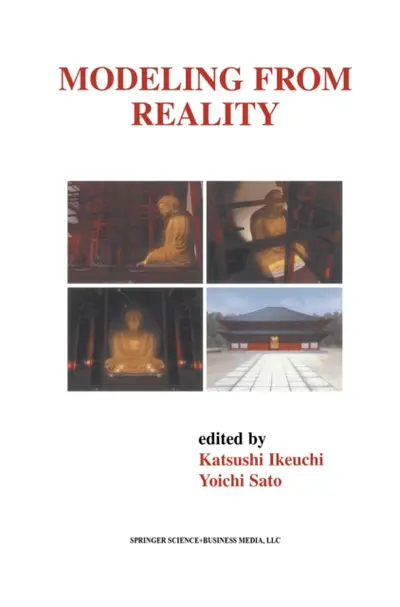
This book summarizes the results of our modeling-from-reality (MFR) project which took place over the last decade or so. The goal of this project is to develop techniques for modeling real objects and/or environments into geometric and photometric models through computer vision techniques. By developing such techniques, time consuming modeling process, currently un- dertaken by human programmers, can be (semi-)automatically performed, and, as a result, we can drastically shorten the developing time of such virtual reality systems, reduce their developing cost, and widen their application areas. Originally, we began to develop geometric modeling techniques that acquire shape information of objects/environments for object recognition. Soon, this effort evolved into an independent modeling project, virtual-reality modeling, with the inclusion of photometric modeling aspects that acquire appearance information, such as color, texture, and smoothness. Over the course of this development, it became apparent that environmental modeling techniques were necessary when applying our techniques to mixed realities that seamlessly combine generated virtual models with other real/virtual images. The material in his book covers these aspects of development.
Bibliographic data © Gardners Books Ltd.