EPUB · English
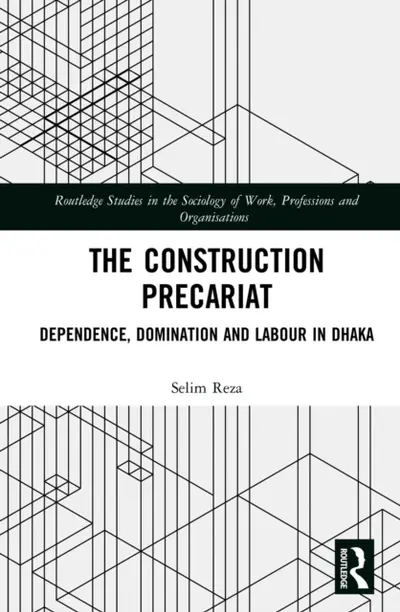
Construction Precariat
Dependence, Domination and Labour in Dhaka
Price and availability
$63.99
Available in: Andorra, Austria, Australia, Belgium, Bulgaria, Canada, Switzerland, Cyprus, Czechia, Germany, Denmark, Estonia, Spain, Finland, France, United Kingdom, Guernsey, Greece, Croatia, Hungary, Ireland, Isle of Man, Iceland, Italy, Jersey, Japan, Liechtenstein, Lithuania, Luxembourg, Latvia, Monaco, Malta, Netherlands, Norway, Poland, Portugal, Romania, Sweden, Slovenia, Slovakia, San Marino, United States, Vatican City, South Africa
Stores: US, UK, Canada, EU, Australia.
Sign in to buyThe price is re-checked by the server before payment.
For personal use under the eBook licence.
- Format
- EPUB
- DRM
- Not stated by the publisher
- Language
- English
- Publisher
- Taylor & Francis
- Published
- 28 July 2020
- ISBN
- 9781000098037
- Subjects
- Bangladesh, Society & culture: general, Social classes, Urban communities, Sociology, Sociology: work & labour, Labour economics, Regional geography, Dhaka, Migration, immigration and emigration, Sociology: work and labour, Construction and building industry
About this book
Positioned within the discourse of neoliberalism and precarious work, this book draws on Guy Standing's notion of "e;the precariat"e; in an examination of the role of recruiting individuals as the key actors in labour recruitment and management practices that produce precarious work conditions. Based on extensive empirical work on migrant construction workers and their recruiters in Dhaka, the capital of Bangladesh and one of the fastest-growing cities in the world, it explores the ways in which exploitative employment relationships contribute to various pressures and insecurities amongst migrant workers and limit the scope for labour protection. Offering new insights into the field of labour migration by unpacking the interconnections between rural-urban labour migration, recruitment and precarious employment, The Construction Precariat conceptualises the domination of recruiters as producing "e;hyper-individualised employment"e;, and sheds light on the manner in which this relationship of domination and dependence contributes heavily both to the conditions of precariousness and to the control and exploitation of migrant workers.
Bibliographic data © Gardners Books Ltd.